
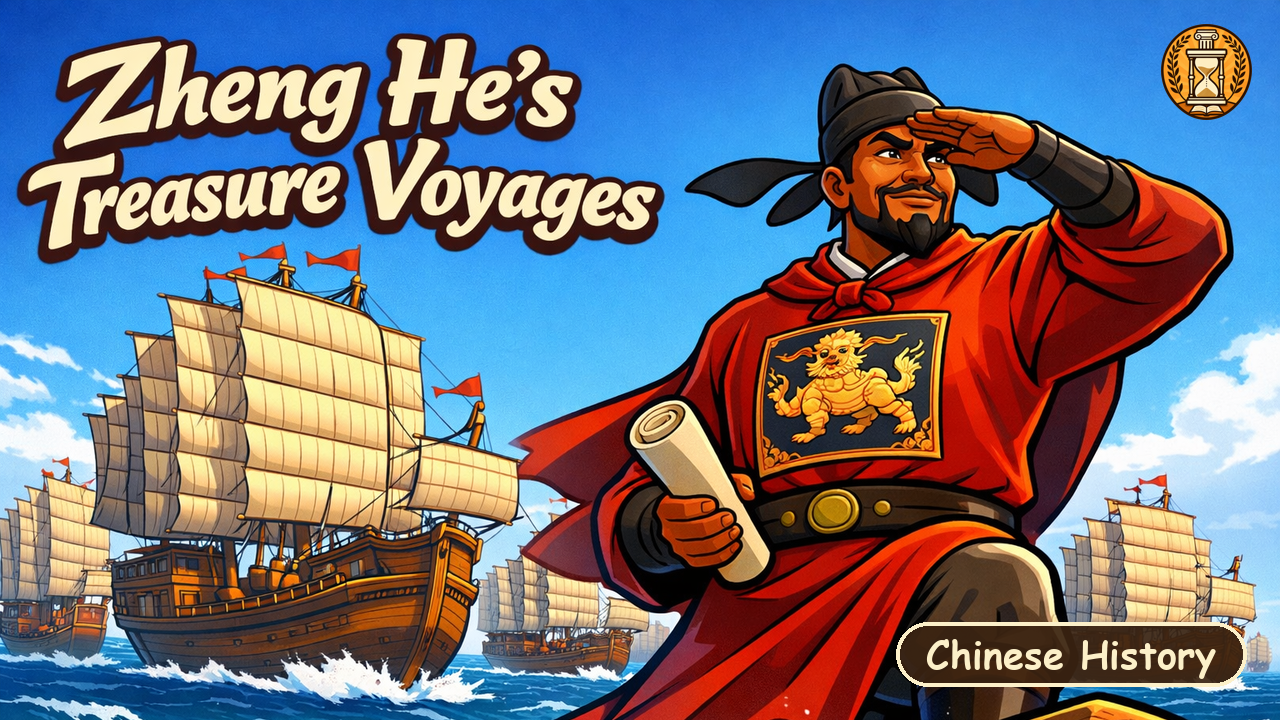
So, you think your boss’s “team-building” cruises are a lot? Try leading 300 ships, 28,000 men, and a floating dragon the size of a football field across the Indian Ocean—and do it seven times.
The Emperor’s Giant Ego Trip
It all starts with Emperor Yongle, a man who believed in doing things big. After seizing the throne in a messy civil war, he needed to prove his legitimacy—and maybe find his missing nephew, who had a habit of disappearing. Yongle’s solution? Build the largest wooden fleet the world had ever seen. At the Nanjing shipyards, workers laid down “treasure ships” that stretched over 400 feet long—four times the length of Columbus’s Santa Maria. These weren’t just boats; they were floating palaces, complete with gardens, private cabins, and enough cargo space to carry a small army’s worth of silk and porcelain. The vessel’s nine masts could hoist sails that, if unfurled, would make a modern aircraft carrier look shy.
Enter the Admiral: Zheng He, the Unlikely Captain
Zheng He wasn’t your typical admiral. He was a eunuch, a Muslim, and a former prisoner of war—three things that don’t exactly scream “naval command.” But Yongle saw something: a brilliant, loyal, and physically imposing man (he stood seven feet tall) who could charm foreign kings and kill pirates with equal flair. So in 1405, Zheng He was handed the keys to the Dragon’s Fleet and told, “Go make the world aware that the Ming Dynasty is the coolest thing since tea.” No pressure.
Voyage One: Pirates, Ports, and Priceless Gifts
The first voyage (1405–1407) kicked off with a bang. The fleet sailed from Nanjing, hit Champa and Siam (modern Vietnam and Thailand), and then made a beeline for India. In Calicut (today’s Kozhikode), Zheng He met the Samoothiri—a local ruler who was equal parts impressed and confused by the Chinese entourage. The Ming gifts included fine silks and gold; the Samoothiri’s return gifts? Black pepper, cardamom, and enough spices to make a medieval European king weep with envy. This was the first official exchange in a pattern: the Chinese gave high-tech luxury goods, and everyone else gave what grew in their backyard.
But the voyage wasn’t all tea and smiles. In the Strait of Malacca, a group of pirates named after their leader, Chen Zuyi, decided to attack. Bad move. Zheng He’s fleet—armed with cannons, crossbows, and sheer mass—annihilated them. The pirate leader was captured and paraded back to Nanjing in chains. Moral of the story: never pick a fight with a man whose ship has its own garden.
The African Connection and the Cost of Glory
By the later voyages (1413–1433), the Dragon’s Fleet had reached East Africa. Zheng He visited the Sultan of Mogadishu, trading Chinese porcelain for giraffes, zebras, and ostriches—animals that caused a sensation back in Beijing. But the real prize was political: Yongle wanted to show that the Ming Dynasty was the center of the world, a “tribute system” where everyone bowed to China. And for a while, it worked.
But glory has a price. Confucian officials at court hated the voyages. They saw them as wasteful, expensive, and—worst of all—fun. Why spend millions on ships when you could spend it on grain silos? After Yongle died, the budget axe fell. Emperor Xuande launched one final voyage in 1431–33, but it was a ghost of its former self. Then the fleet was mothballed. Shipbuilding records were burned. The Dragon’s Fleet became a legend gathering dust.
The Punchline
And so the Ming Dynasty’s answer to space exploration—a fleet that could have colonized the world—was canceled because of paperwork, politics, and a deep-seated fear of having too much fun. Next time your boss cancels your vacation, remember: even Zheng He couldn’t outrun the bureaucrats.
Chapters
- 0:00 — Introduction
- 0:20 — Yongle orders expeditions
- 0:47 — Fleet construction at Nanjing
- 0:55 — The Ground
- 1:00 — Fleet construction at Nanjing
- 1:27 — First voyage departs
- 2:05 — Arrival at Calicut
- 2:46 — First voyage returns
- 3:24 — Second voyage: 1407-1409
- 3:52 — Third voyage: 1409-1411
- 4:35 — Fourth voyage: 1413-1415
- 5:29 — Fifth voyage: 1417-1419
- 6:29 — Sixth voyage: 1421-1422
- 7:00 — Yongle dies, voyages halted
- 7:32 — Hongxi reign ends
- 8:07 — Seventh voyage ordered
- 8:47 — Seventh voyage departs
- 9:22 — Zheng He dies at Calicut
- 10:00 — Fleet returns, voyages end
- 10:41 — Legacy of the voyages


