
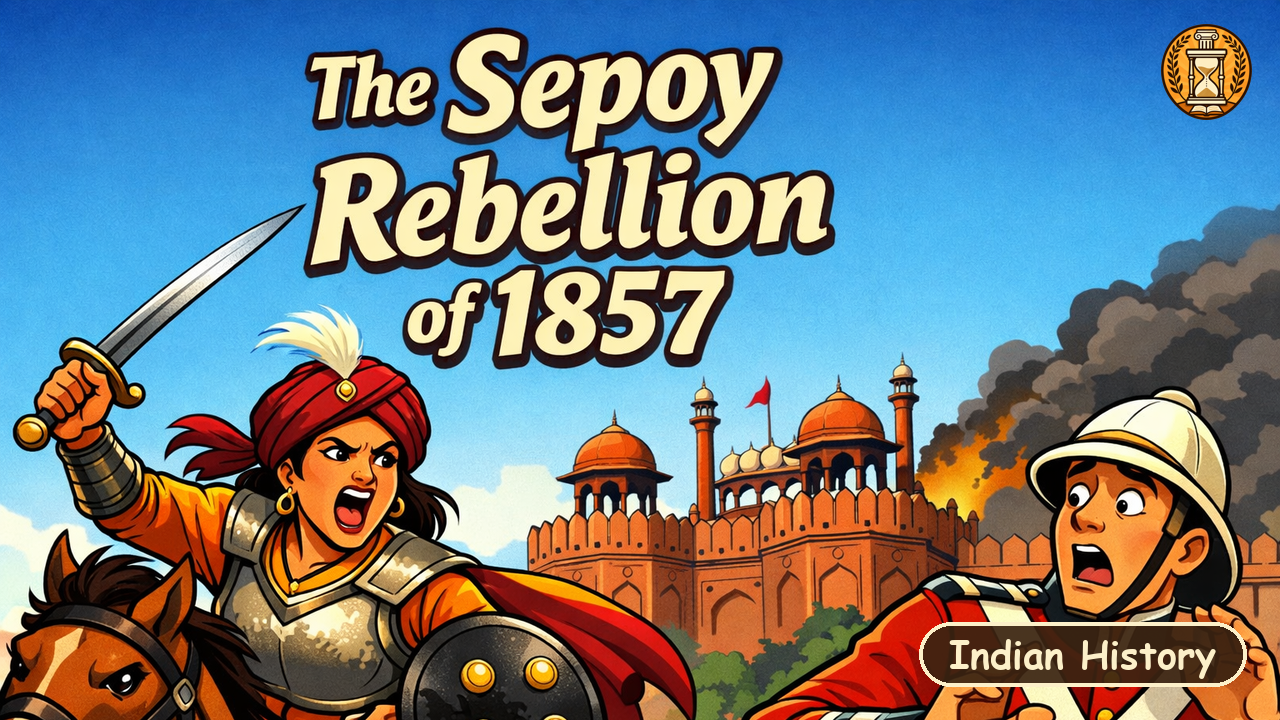
Let’s get one thing straight: the British East India Company was not a government. It was a corporation with a private army, a talent for tax collection, and the diplomatic charm of a bulldog in a china shop. By 1857, it had been running India for a century, and its employees were about to learn a very expensive lesson in supply-chain management.
The Grease That Broke the Camel’s Back
It all started with a rumor about a new rifle. The Enfield Pattern 1853 was a lovely piece of kit, but loading it required biting off the end of a greased paper cartridge. The grease, as it turned out, was a blend of beef tallow and pork lard. For Hindu sepoys, cow fat was a religious abomination; for Muslim sepoys, pork was a hard no. The Company, in a move that would make a modern PR firm weep, told the soldiers: “Just use it, it’s fine.”
It was not fine. In Meerut, 85 sepoys refused to bite. They were court-martialed, stripped of their uniforms, and thrown in irons—in front of their entire regiment. This was the corporate equivalent of firing your best employees for using the wrong brand of coffee and then posting the memo on the breakroom wall. On May 10, 1857, the rest of the garrison snapped. They broke open the jail, shot their officers (General Hewitt, the local commander, was reportedly more interested in his afternoon nap than in stopping them), and marched 40 miles to Delhi. The Great Uprising had begun.
A Very Reluctant Emperor
The rebels needed a figurehead, and they found one in Bahadur Shah Zafar. The 82-year-old Mughal emperor was a poet, a mystic, and a man whose kingdom had shrunk to the Red Fort in Delhi. He was, by all accounts, more interested in writing ghazals than in ruling an empire. But the sepoys stormed his palace and proclaimed him Emperor of Hindustan. Zafar, probably thinking, “Well, this is a terrible idea, but my alternative is being hanged,” accepted.
For a few glorious months, Delhi was rebel headquarters. The Company’s response was to send General Barnard and later John Nicholson—a man so aggressive he made the Terminator look like a pacifist—to besiege the city. The siege was a brutal, six-month slog through heat, disease, and street fighting. Nicholson died storming the walls, which was probably the only way he would have stopped. When the British retook Delhi, they didn’t just win; they exiled Zafar to Rangoon and banned him from ever returning to his beloved city. He died there, writing poems about his lost kingdom.
The Queen of Jhansi and the Massacre That Got Ugly
Down south, the rebellion had its own cast of characters. In Jhansi, the young Rani Lakshmibai—a woman who rode horses, wielded swords, and had zero patience for British land-grabbing—took up arms after the Company tried to annex her kingdom on a technicality. She became the face of resistance, fighting in men’s clothing and dying in battle with her sword raised. She is, to this day, the coolest person in this story.
But the darkest chapter was Cawnpore (modern Kanpur). Nana Sahib, the adopted son of a former Peshwa, had a legitimate grievance: the Company refused to recognize his inheritance. He besieged the British garrison, which surrendered after weeks of starvation and cannon fire. The British were promised safe passage to boats on the Ganges. Instead, they were fired upon from the riverbank. The surviving men were executed; the women and children were taken prisoner and later killed in a building called the Bibighar. When General Havelock and the famously ruthless General Neill arrived, they went on a revenge spree that made the original massacre look like a polite disagreement. Neill’s method? Force every captured rebel to lick the bloodstained floor of the Bibighar before hanging them. It was “justice” served with a side of pure madness.
The Aftermath: A Corporation Goes Bankrupt
By 1858, the rebellion was crushed. Tantia Tope, Nana Sahib’s brilliant guerrilla general, was betrayed and hanged. But the Company was done too. The British government, horrified by the cost in blood and treasure, abolished the East India Company and took over India directly under Queen Victoria.
So, the uprising failed in its goal of ending British rule. But it succeeded in killing the Company. The rebels didn’t win the war, but they did manage to fire the most incompetent CEO in history. And that, dear reader, is the one thing a corporation never forgives.
Chapters
- 0:00 — Introduction
- 0:58 — Meerut Mutiny
- 1:09 — The Ground
- 1:13 — Meerut Mutiny
- 1:34 — Rebels Take Delhi
- 2:17 — Siege of Delhi Begins
- 2:52 — Cawnpore Surrender
- 3:53 — Massacre at Bibighar
- 4:29 — Siege of Lucknow Begins
- 5:14 — On the Move
- 5:17 — First Relief of Lucknow
- 6:00 — Storming of Delhi
- 6:43 — Fall of Delhi and Exile of Zafar
- 7:33 — Massacre at Satichaura Ghat
- 8:21 — Second Relief of Lucknow
- 9:03 — Siege of Jhansi
- 9:39 — Battle of Kotah-ki-Serai
- 10:19 — Capture of Tatya Tope
- 11:08 — End of East India Company

