Picture the year 1200 BCE. The Mediterranean is a glittering, bustling superhighway of trade, bronze weapons, and palace bureaucrats meticulously recording grain shipments on clay tablets. Then, in the span of a few generations, the lights go out. Kingdoms vanish. Writing systems die. Cities are torched. It’s as if the entire region collectively decided to rage-quit civilization and go back to subsistence farming. This is the Bronze Age Collapse—history’s first great system-wide crash, and the original “everything is fine” meme before the punchline.
The Sea Peoples: The Ancient World’s Most Wanted
Every mystery needs a villain, and the Bronze Age Collapse has the most gloriously vague one in history: the Sea Peoples. We don’t know exactly who they were, where they came from, or even if they were one group or a loose coalition of maritime marauders. What we do know is that they showed up like a bad houseguest, wrecking the place and leaving before anyone could get their name. Egyptian texts describe them as a confederation of raiders who smashed coastal cities from Anatolia to the Levant. They were the kind of guys who don’t just burn your crops—they burn the clay tablets that say how much crop you had.
The Hittite Empire, headquartered in modern Turkey, was a superpower with iron-forging tech and a capital that seemed unassailable. Under King Suppiluliuma II, they fought back. They staged naval battles and land skirmishes. It didn’t matter. The Hittites vanished so completely that their language was lost for 3,000 years. Their royal archives? Baked into rubble. When you lose to a group whose name is basically “the guys from somewhere else,” you know it’s a bad decade.
Palaces Go Up in Smoke (Literally)
Meanwhile, in Greece, the Mycenaeans were living their best Iliad fantasy—massive stone palaces, gold masks, wine, and linear B script. Then, around 1200 BCE, nearly every major Mycenaean palace was destroyed by fire. Pylos, Mycenae, Tiryns—all torched. We know because the clay tablets that survived the fires are the ones that list emergency measures: “Send rowers,” “Deploy bronze-smiths.” It’s like finding a voicemail from a doomed CEO saying, “We’re restructuring.”
The collapse wasn’t one event. It was a cascade. Palaces were the engines of the economy: they stored grain, organized labor, and redistributed food. When they burned, the system died with them. Writing disappeared. Trade routes went silent. The Greeks forgot how to write for 400 years—an era we charmingly call the “Greek Dark Ages,” which was less Netflix original and more “candlelit cave with a goat.”
The Hungry, Hungry Catastrophe
But wait—was it all swords and fire? Not quite. The real killer might have been the weather. Tree-ring and pollen data suggest a massive drought and famine across the Eastern Mediterranean. When crops fail, desperate people do desperate things—like sack a palace for its grain. The Sea Peoples may have been less a conquering horde and more a wave of climate refugees with boats and bronze axes. That doesn’t make them less terrifying, just more understandable. “I’m not pillaging, I’m just looking for a gluten-free option.”
Famine toppled supply chains. Earthquakes added insult to injury. And when the Hittites fell, the entire diplomatic network—treaties, trade pacts, royal marriages—collapsed like a Jenga tower. Egypt, the last great power standing, watched the chaos from the Nile Delta and thought, “Not on my watch.”
Ramesses III: The Last Doorstop
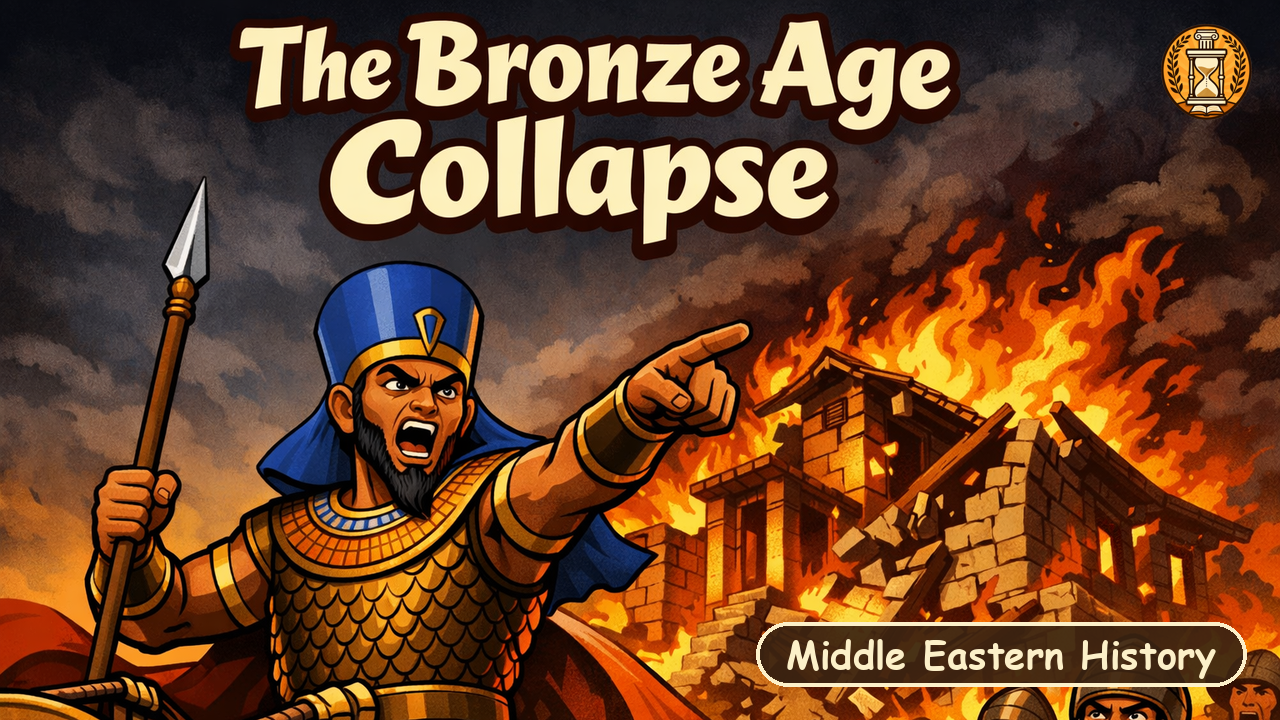
Egypt’s pharaoh Ramesses III is the hero of this story, though “hero” here means “the guy who didn’t immediately die.” Around 1177 BCE, he faced a massive land-and-sea invasion by the Sea Peoples. He built a fleet, lured the enemy into the Nile, and annihilated them with archers and grappling hooks. Egyptian records celebrate it as a glorious victory. The reliefs show piles of severed hands. Classic pharaoh energy.
But even Ramesses couldn’t save the system. Egypt survived, but it was a hollowed-out shell. The pharaoh’s state coffers were drained, corruption spread, and within a century, the Bronze Age’s last superpower shriveled into petty squabbling. Ramesses III himself was assassinated in a harem conspiracy—by his own wife and son. Because in the Bronze Age, even the victors got stabbed in the back.
The collapse wasn’t one cause. It was a perfect storm: invaders, drought, earthquakes, and a brittle economic system that couldn’t adapt. The Bronze Age empires were like social-media influencers—huge online, but one bad algorithm and they were gone.
The lesson? Diversify your economy, don’t put all your grain in one palace, and maybe be nice to the sailors. Because when the seas rise—literally or metaphorically—the Sea Peoples are just the guys who show up first.
Chapters
- 0:00 — Introduction
- 0:14 — The Setting
- 0:24 — Mycenaean Palaces Flourish
- 0:43 — Hittite Empire Dominates Anatolia
- 0:58 — Egyptian-Hittite Peace
- 1:26 — Ugarit Thrives as Trade Hub
- 1:37 — On the Move
- 1:41 — Ugarit Thrives as Trade Hub
- 2:02 — First Raids on Egypt
- 2:43 — Mycenaean Palaces Burn
- 3:18 — Hittite Famine and Plea
- 3:55 — Ugarit’s Desperate Plea
- 4:37 — Sea Peoples Mass at Cyprus
- 4:59 — Ugarit Destroyed
- 5:27 — Hattusa Abandoned
- 5:54 — Egypt Under Attack
- 6:34 — Ramesses III’s Victory
- 7:03 — Egypt Survives but Weakened
- 7:37 — Tausret’s Rule and Fall
- 8:09 — Setnakhte Restores Order