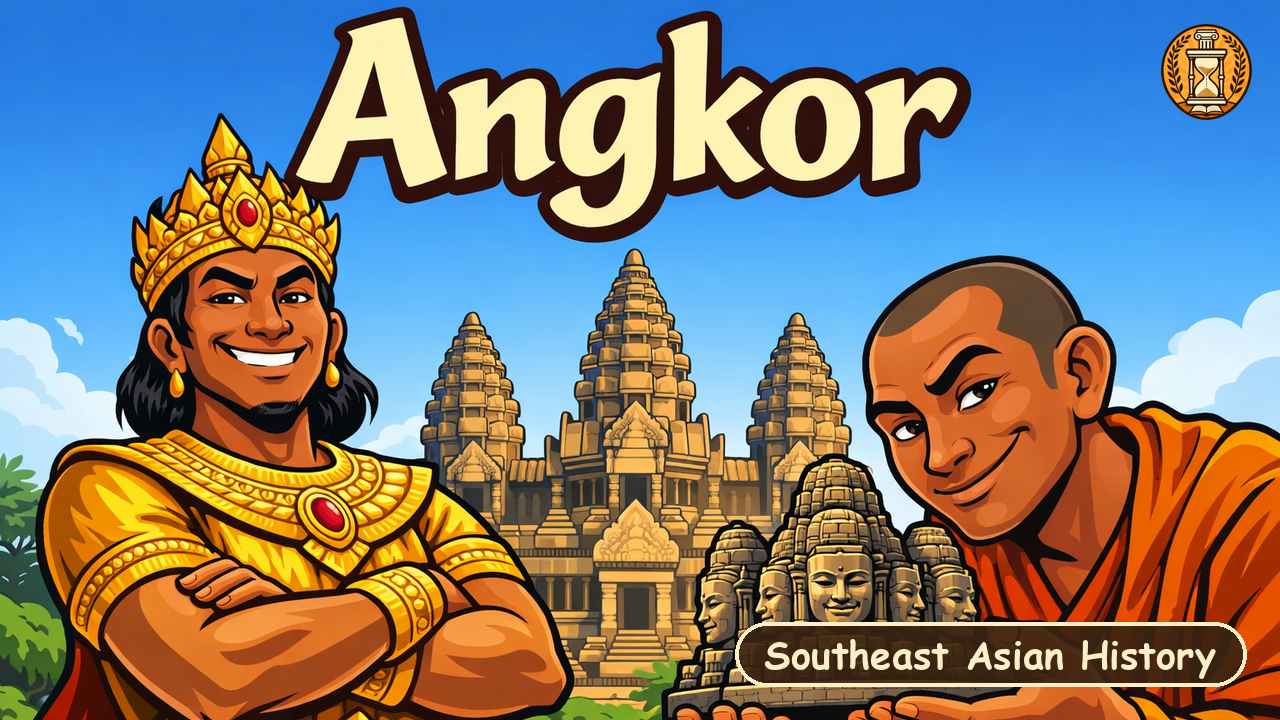
So you want to build a city that will outlast your empire, your gods, and possibly the jungle itself? Step one: find a really big plot of land. Step two: declare yourself a god. Step three: get very, very good at plumbing. Welcome to Angkor.
The God-King Starter Pack
It all starts in 802 CE with a guy named Jayavarman II, who had the kind of ambition that usually gets you a reality TV show. He didn’t just want to be king of the Khmer. He wanted to be chakravartin — the “universal monarch.” To make this stick, he established the devaraja cult, which is a fancy way of saying “I am literally a god on Earth, so please stop asking questions and pay your water taxes.”
This wasn’t just ego. By blurring the line between temple and throne, Jayavarman set the template for every ruler after him: build a temple-mountain that represents Mount Meru, the center of the Hindu universe. If you could build a mountain out of sandstone and call it your office, you were basically untouchable. The first temple-mountains were essentially celestial real estate agents — they sold the idea that the king’s power was written into the cosmos itself.
The World’s Most Ambitious Sandcastle
Now, being a god is great, but even gods need agriculture. The Khmer weren’t just stacking stones; they were engineering one of the most sophisticated water management systems in the pre-modern world. Kings dug massive barays — gigantic reservoirs the size of small counties — and a lattice of canals that turned monsoon chaos into a year-round irrigation system. It was the ancient equivalent of building a smart grid, except instead of algorithms, it ran on forced labor and sheer stubbornness.
The crowning glory, though, is Angkor Wat. Built under Suryavarman II in the 12th century, it’s the largest religious monument on Earth. It’s so perfectly aligned with the sun that on the equinox, the sun rises directly over the central tower. That’s not luck; that’s a medieval king saying, “I arranged the solar system to match my vacation home.” Angkor Wat is a masterpiece of art and symmetry, which makes it all the more tragic that Suryavarman II spent so much on it that his successors had to deal with the financial hangover for centuries.
The City That Swallowed a Forest
Angkor reached its peak size under Jayavarman VII, a man who saw his predecessor’s temple and said, “Cute. Now hold my beer.” He built the walled city of Angkor Thom, the Bayon temple with its serene, giant faces staring in every direction, and a hospital system that would make a modern HMO blush. At its height, Angkor was a megacity of roughly a million people — the largest urban complex in the pre-industrial world. Imagine Los Angeles, but with more elephants and fewer traffic jams.
But here’s the rub: mega-cities have mega-problems. The same canals that made Angkor rich also made it brittle. Deforestation for construction and rice farming stripped the landscape. The massive water system silted up, and a series of severe droughts followed by violent floods turned the city’s lifeblood into its Achilles’ heel.
The Unraveling
The end wasn’t a single disaster but a slow, messy collapse. In 1177, the Cham invaded and sacked the city — a shocking, humiliating blow that Jayavarman VII avenged, but the cracks were showing. Then came the real killer: the Ayutthaya Kingdom. In 1431, King Borommaracha II of Ayutthaya marched in and sacked Angkor again. This time, the Khmer didn’t rebuild. They moved south, closer to the coast, and left the city to the jungle.
For centuries, the temples were swallowed by strangler figs and silk-cotton trees. The great god-kings became whispers, and the great reservoirs became mosquito swamps. The city didn’t fall to a single sword; it died of a thousand cuts — climate change, resource exhaustion, political infighting, and one very determined Thai army.
The punchline? The Khmer Empire built a city that was so grand, so complex, so extra, that it took the jungle and history itself to finally bring it down. And even then, the jungle lost. Angkor Wat is still standing, not as a monument to a dead god-king, but as a reminder that if you’re going to be arrogant, at least be arrogant with excellent masonry.
Chapters
- 0:00 — Introduction
- 0:14 — The Setting
- 0:23 — Jayavarman II unifies Cambodia
- 0:46 — Indravarman I builds reservoirs
- 1:29 — Yasovarman I moves capital
- 2:14 — Suryavarman II builds Angkor Wat
- 2:53 — Jayavarman VII defeats Chams
- 3:29 — The Ground
- 3:32 — Jayavarman VII builds Bayon
- 4:24 — Jayavarman VII builds hospitals
- 5:02 — Zhou Daguan visits Angkor
- 5:43 — Decline of hydraulic system
- 5:54 — On the Move
- 5:58 — Decline of hydraulic system
- 6:36 — Rise of Ayutthaya
- 7:09 — First Siamese sack of Angkor
- 7:50 — Khmer reconquest
- 8:38 — Environmental stress
- 9:25 — Final Siamese invasion
- 10:18 — Abandonment of Angkor