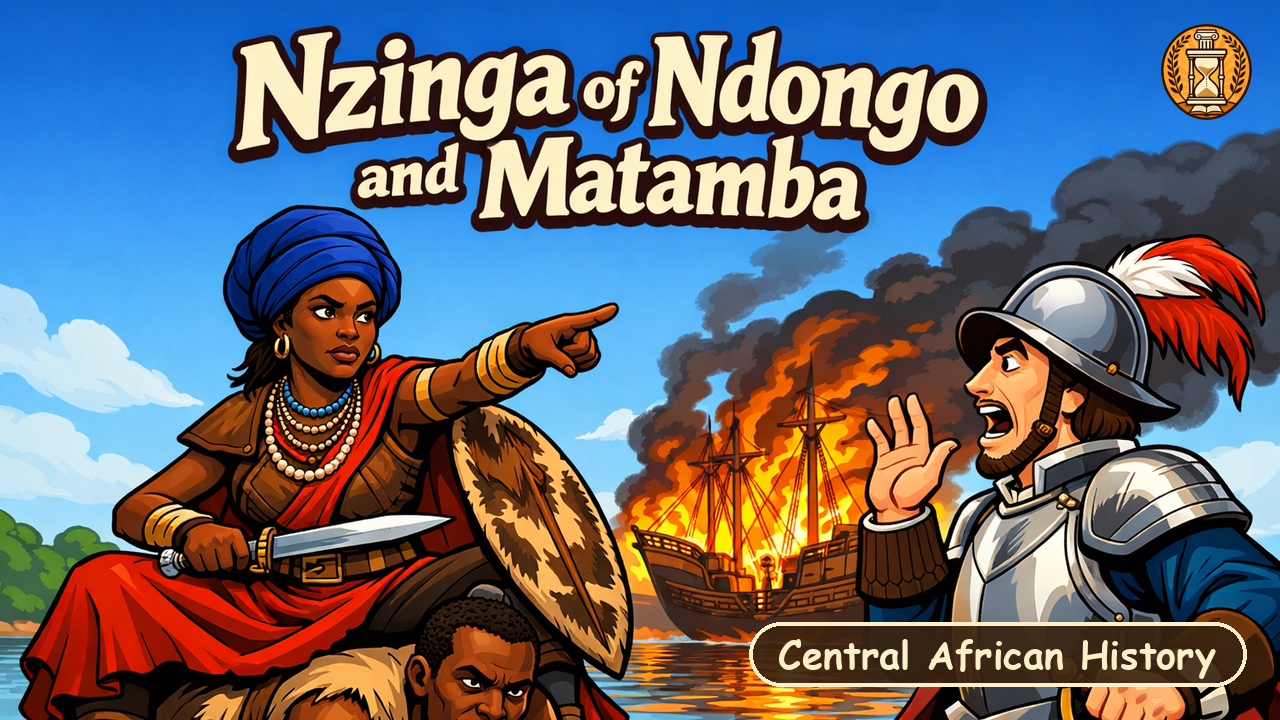
She walked into the room, saw the governor’s plush velvet chair, and thought, “Absolutely not.” Then she used her servant as a human ottoman. This is the story of Nzinga Mbande, the queen who turned diplomatic shade into a weapon of mass resistance.
The Princess and the Portuguese Problem
Born around 1583, Nzinga grew up in the kingdom of Ndongo (modern-day Angola) while the Portuguese were doing what the Portuguese did best in the 16th century: showing up, demanding souls and ivory, and calling it “trade.” Her father, Ngola Mbandi, spent his reign fighting off these incursions with the grim determination of a man who knows the other side has better artillery. Spoiler: he lost more than he won, but he taught his daughter that surrender was a dish best served never.
When her brother (also confusingly named Ngola Mbandi—the Mbandis were not big on creative names) took the throne, he faced a crisis. The Portuguese had him boxed in, and his only move was to send his sister to Luanda to negotiate. Nzinga didn’t just walk into the governor’s palace; she walked into a trap. Governor João de Sousa offered her a chair—but only a floor mat. The message was clear: you are a vassal, not a guest.
Nzinga’s response was so iconic it deserves its own action figure. She refused the mat, called for one of her attendants, and made the poor woman get on all fours. She then sat on her servant’s back, leveled her gaze at the governor, and conducted the entire negotiation from her new, human-made throne. It was a power move so audacious that Sun Tzu would have taken notes. She got the treaty she wanted, and the Portuguese learned that this was not a woman who accepted the seating chart.
The Brother Who Couldn’t Handle It
Back home, Nzinga’s brother was having a bad time. The treaty she’d negotiated was crumbling, the Portuguese were pressing harder, and the king was facing rebellion from within. History records that he ultimately took his own life in a moment of despair—leaving Nzinga in charge of a kingdom that was basically on fire.
Now, here’s where Nzinga showed she wasn’t just a diplomat with great posture. She inherited a war, not a parade. The Portuguese thought they’d get a puppet queen. Instead, they got a woman who would happily burn her own capital city to avoid surrendering it. She formed a strategic alliance with the Imbangala, a fierce warrior group led by a man named Kaza. It was a marriage of convenience that involved a lot of ritual violence and, famously, some questionable symbolism involving a basket. (Let’s just say the ceremony was not church-approved, and move on.)
The Christian Queen Who Kept Her Edge
When the Portuguese got too strong, Nzinga did what any pragmatic ruler would do: she converted to Christianity. Why? Because the Church had sway with the colonial powers, and a baptismal name was cheaper than a battalion. She took the name Dona Ana de Sousa—a subtle jab at the governor—and used the alliance to buy time, regroup, and eventually seize control of the neighboring kingdom of Matamba.
But here’s the twist: she used her Christian identity not as submission, but as armor. When the Dutch arrived (because everyone wanted a piece of Angola), Nzinga negotiated with them directly. She even allied with the Dutch commander against the Portuguese. Her religion was a tool, her alliances were transactional, and her goal was singular: get the Portuguese out of her land. She led her armies into battle well into her 60s, and when she finally died in her 80s, she had done what no other ruler had managed—she kept Ndongo and Matamba free from Portuguese conquest during her entire reign.
The Chair That Echoes
Nzinga’s legacy isn’t just a story about a chair. It’s about a woman who understood that power is a performance, and she was the star. She used diplomacy, warfare, religion, and sheer audacity to outmaneuver a colonial empire. She was a queen who fought slavers, allied with slavers, and then fought slavers again—history is messy, but her aim was always clear.
Today, she stands as a symbol of African resistance, proof that the colonial narrative wasn’t a one-way street. And every time you see a power broker at a fancy meeting, remember: the original boss move wasn’t a corner office. It was a human footstool.
Chapters
- 0:00 — Introduction
- 0:14 — On the Move
- 0:18 — The Setting
- 0:27 — Nzinga’s Birth at Kabasa
- 0:49 — Portuguese Slave Raids Intensify
- 1:49 — Nzinga’s Education and Diplomacy
- 2:40 — Death of Ngola Mbandi
- 3:32 — Nzinga’s Embassy to Luanda
- 4:11 — Treaty of Luanda
- 5:07 — Brother’s Suicide
- 5:51 — Nzinga Becomes Queen
- 6:32 — Portuguese Invasion of Ndongo
- 7:07 — Alliance with Imbangala
- 7:48 — Conquest of Matamba
- 8:37 — Dutch Alliance
- 9:40 — Battle of Kombi
- 10:24 — Portuguese Counterattack
- 10:53 — Peace Negotiations
- 11:43 — Conversion to Christianity
- 12:22 — Nzinga’s Later Reign