The Aztec Empire didn’t fall because of a prophecy, a misunderstanding, or even guns—it fell because Hernán Cortés arrived with the diplomatic equivalent of a wrecking ball, a few cannons, and a truly spectacular run of bad luck for everyone else.
The City That Rose From a Swamp (and Had a Great Real Estate Agent)
In 1325, a nomadic tribe with a bloodthirsty sky-god named Huitzilopochtli saw an eagle perched on a cactus, eating a snake, on a muddy island in Lake Texcoco. Their god reportedly said, “Build here.” And they did. Because when your deity is a hummingbird-obsessed war god who demands human hearts, you don’t argue with his zoning decisions. Tenochtitlan grew from a mosquito-infested bog into a Venice-like marvel of canals, aqueducts, and floating gardens. By the time Itzcoatl and his brilliant ally Nezahualcoyotl formed the Triple Alliance in 1428, the Aztecs were less a tribe and more a tribute-collecting corporation with a side hustle in human sacrifice. They even invented the “Flower War”—a ritualized battle specifically designed to capture prisoners for sacrifice, which is the historical equivalent of a football game where the losing team gets their hearts ripped out on the 50-yard line.
The King Who Saw Too Many Signs (and Ignored Them All)
Moctezuma II took the throne in 1502 and inherited a realm that stretched from the Gulf to the Pacific, funded by a tribute system that made the IRS look merciful. But then came 1517, and the omens started rolling in like a bad movie trailer: a comet, a temple spontaneously catching fire, a bird with a mirror in its head showing distant horsemen. Modern historians suspect these were recorded after the Spanish arrived—hindsight is 20/20, even in Nahuatl—but Moctezuma reportedly panicked. When Cortés landed at Veracruz in 1519, the emperor’s fatal error wasn’t cowardice. It was indecision. He sent gifts of gold—so much gold that the Spanish started melting it into bars while thinking, “This is great, but what if we took the whole store?” He also believed Cortés might be Quetzalcoatl, the feathered serpent god. That’s like thinking the guy who knocked on your door selling magazine subscriptions is actually Zeus, and then inviting him in for tea.
The Translator Who Rewrote History
Cortés didn’t conquer Mexico with 500 soldiers; he conquered it with a woman. Malintzin, better known as La Malinche, was a Nahua woman gifted to the Spanish as a slave. She spoke Nahuatl and Maya, and within weeks learned Spanish. She became Cortés’s voice, his negotiator, and his strategic brain in a skirt. Thanks to her, Cortés realized the Aztec empire was a house of cards built on the resentment of thousands of tributary city-states. The Tlaxcalans, the Aztecs’ sworn enemies, hated them so much they allied with the Spanish—a decision they’d later regret, but at the time, it seemed like a solid plan. Xicotencatl the Younger, a Tlaxcalan prince, initially fought the Spanish hard, then pragmatically joined them, proving that politics makes for strange bedfellows and even stranger massacre partners.
The Siege That Ended the World
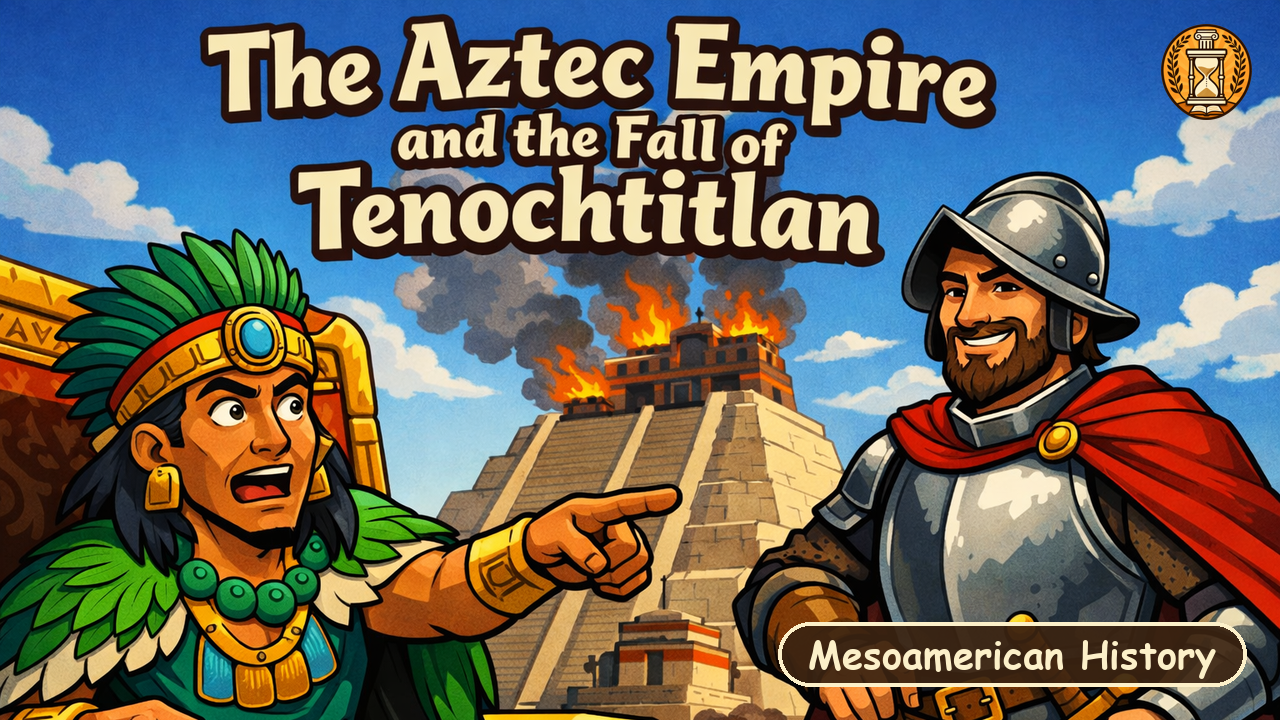
Cortés and his allies marched into Tenochtitlan, where Moctezuma greeted them—and was promptly taken hostage in his own palace. Then things went pear-shaped. Pedro de Alvarado, Cortés’s hot-headed lieutenant, massacred nobles during a festival while Cortés was away, sparking an uprising. Moctezuma tried to calm his people, got hit by a rock (possibly his own citizens, possibly Spanish), and died. The Spanish fled the city on the infamous “Noche Triste,” losing half their men and all their gold in the canals. But they came back. With a fleet of brigantines, a smallpox epidemic that devastated the Aztec population, and the siege of Tenochtitlan—a brutal, 75-day campaign that combined starvation, disease, and street fighting. The last emperor, Cuauhtémoc, surrendered in 1521. The city that once floated on water was reduced to rubble, and the Spanish built Mexico City on top of it, which is the most efficient form of urban renewal ever attempted.
The Aztecs didn’t fall to guns and gold alone. They fell to division, disease, and a Spanish leader who understood that the best weapon in 16th-century Mexico wasn’t a cannon—it was a grudge.
Chapters
- 0:00 — Introduction
- 0:57 — Alliance with Totonacs
- 1:42 — Scuttling of the ships
- 2:25 — On the Move
- 2:29 — March to Tlaxcala
- 3:03 — Massacre of Cholula
- 3:50 — Moctezuma welcomes Cortés
- 4:28 — The Ground
- 4:33 — Moctezuma welcomes Cortés
- 4:46 — Cortés takes Moctezuma hostage
- 5:25 — Narváez expedition arrives
- 6:17 — Cortés defeats Narváez
- 7:02 — Massacre of Toxcatl
- 7:52 — Moctezuma’s death
- 8:33 — La Noche Triste
- 9:17 — Battle of Otumba
- 10:07 — Smallpox epidemic
- 10:51 — Siege of Tenochtitlan begins
- 11:33 — Cortés captures Cuauhtémoc
- 12:12 — Fall of Tenochtitlan