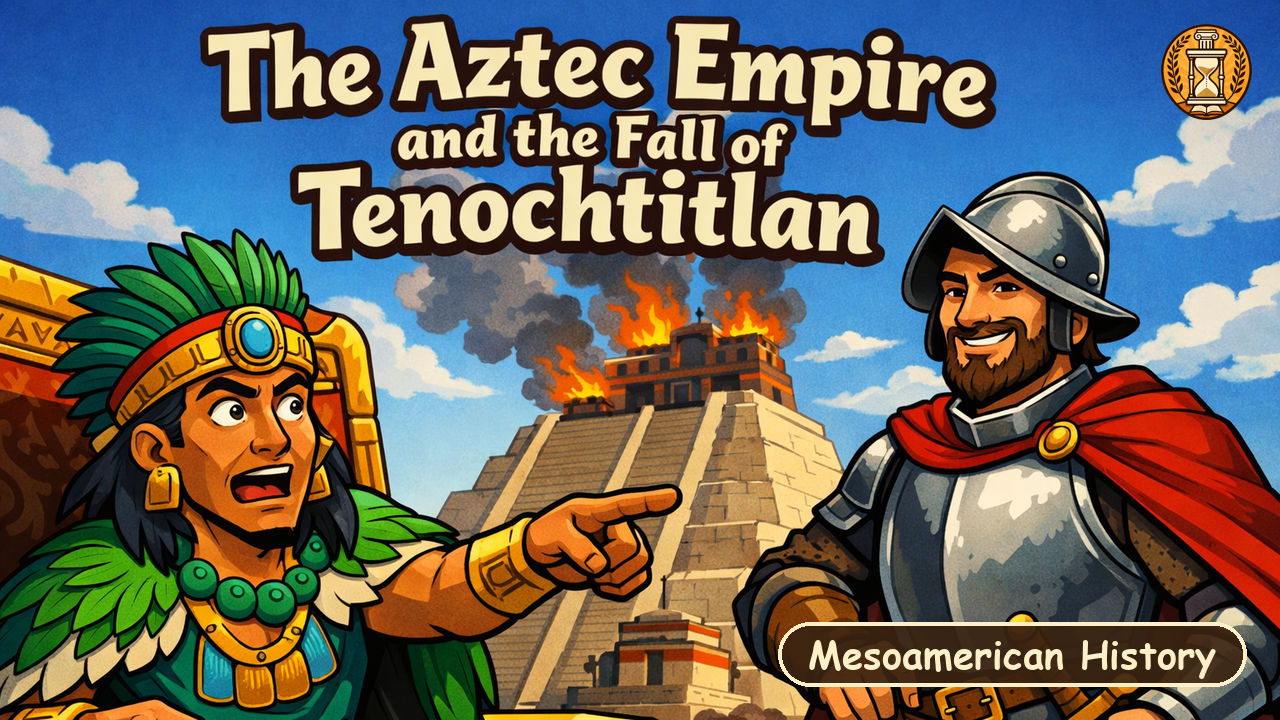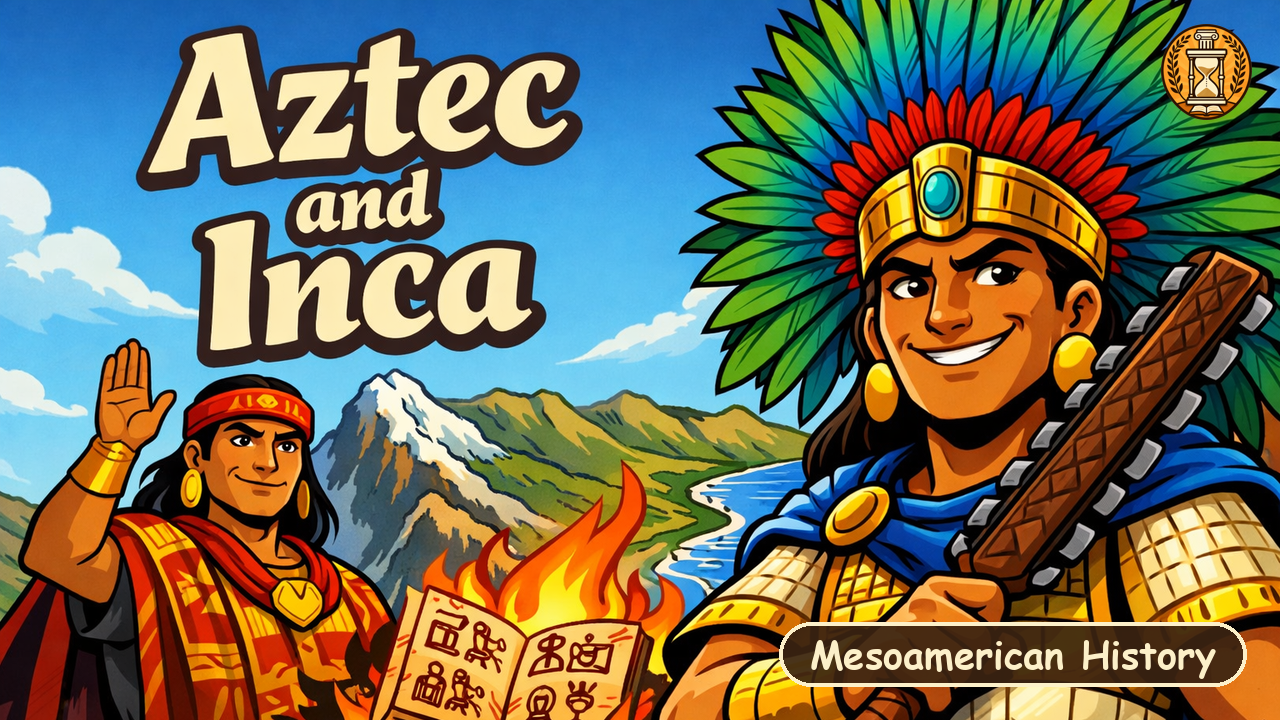
Two empires, zero idea they existed. That’s history’s cruelest punchline: the Aztecs and Inca were busy building the Western Hemisphere’s biggest shows while having absolutely no clue the other was selling tickets. One ran on flowery, theatrical war; the other on ruthless, bureaucratic conquest. Both ended up splattered by a handful of Spaniards with horses and bad colds. Let’s meet the fighters, minus the smallpox.
The Triple Alliance: Three’s a Crowd, Unless You’re Conquering
In 1428, the Valley of Mexico was a messy game of musical thrones. Then Itzcoatl, the Aztec leader, decided the music should stop—and he should hold all the chairs. He teamed up with the Texcoco king Nezahualcoyotl (a poet-warrior who somehow balanced verses and violence) and Tlacopan’s nobility to form the Triple Alliance. That’s right: three city-states, one murderous pyramid scheme. Together, they crushed Texcoco’s rivals, then Tlacopan’s rivals, then everyone else’s rivals. The Aztecs of Tenochtitlan quickly became the senior partner, mostly because their god demanded hearts, but also because they had a genius PR guy: Tlacaelel.
Tlacaelel, Itzcoatl’s nephew and chief ideologue, invented the brand. He rewrote history to make the Aztecs look chosen by the sun, then boosted the population by building chinampas—floating garden rafts that turned a swampy lake into a farm-to-table empire. More people meant more soldiers, more tribute, and more sacrificial victims. Efficiency, people.
The Flower Wars: Combat as Performance Art
Here’s where it gets delightfully weird. The Aztecs didn’t always fight to win territory. They fought xochiyaoyotl, or Flower Wars—pre-arranged, ritualized battles against rival city-states like Tlaxcala. The goal wasn’t land; it was capturing prisoners for sacrifice. Think of it as a sports league where the trophy is a beating heart and the losers get politely escorted to the altar.
This was genius if you wanted cosmic approval, but terrible if you wanted a stable empire. The Aztecs under Moctezuma I (Itzcoatl’s successor) kept fighting these polite scuffles while neighboring states stayed armed and bitter. It’s like challenging a rival to a chess match, then being shocked when they show up with a shotgun later. The Flower Wars gave the gods their fix, but they also left the Aztec military training for ballet while the real world practiced rugby.
The Inca: Pachacuti’s Glow-Up
Meanwhile, 4,000 miles south, the Inca were having their own crisis. In 1438, the Chanca—a fierce rival tribe—rolled up to the Inca capital, Cusco, ready to end the party. King Viracocha Inca, showing leadership skills best described as “cowardly,” fled with his heir. But his other son, Pachacuti Inca Yupanqui, stayed behind with a scrappy defense. Against the odds, he smashed the Chanca at the Battle of Yawarpampa (“Bloody Plain”), and the Chanca leader, Anco Huayllu, got to enjoy a hasty retreat.
Pachacuti didn’t just win; he rebranded. He reorganized the Inca army into a disciplined, standardized machine—no flower wars here. Every conquered people got a choice: submit and join the empire (with perks like state-sponsored corn beer), or resist and get relocated to a distant province. He also launched the Qhapaq Ñan, a massive road system linking Cusco to the empire’s far corners. Think Roman roads, but with more llamas and fewer aqueducts. This let troops move faster than gossip, and Pachacuti’s son, Topa Inca Yupanqui, used it to expand the realm to its peak, from modern Ecuador to Chile.
Two Ways to Lose an Empire
Compare the two: Aztecs used war as a religious drama, with rigid rules and a focus on capture. Inca used war as a bureaucratic procedure, with logistics and assimilation as the weapons. The Aztecs ruled by fear and ritual; the Inca ruled by infrastructure and resettlement. One built floating gardens; the other built mountain highways. Both thought they were the center of the world—because, technically, they were the centers of their worlds.
But neither could handle a guy with a steel sword and a horse. The Aztecs’ flower wars left them without allies; the Inca’s road system helped Spanish invaders march straight to Cusco. Turns out, all that organization just made it easier to conquer.
So, who was better at empire-building? Depends on your metric. The Inca were more stable and humane-ish; the Aztecs were better at spectacle. But both shared one fatal flaw: they never looked beyond their own horizon. And in 1532, the horizon looked back—with cannons.
History’s lesson? Always build a navy, or at least a mutual defense pact with someone who owns a coastline.
Chapters
- 0:00 — Introduction
- 0:38 — Itzcoatl burns historical codices
- 1:09 — Moctezuma I expands empire
- 1:19 — On the Move
- 1:23 — Moctezuma I expands empire
- 1:43 — Flower Wars begin
- 2:17 — Tlacaelel promotes human sacrifice
- 2:44 — The Ground
- 2:49 — Pachacuti becomes Inca
- 3:20 — Pachacuti rebuilds Cusco
- 3:39 — Inca conquest of the Andes
- 4:33 — Topa Inca campaigns north
- 5:21 — Aztec Flower War vs Tlaxcala
- 6:21 — Huayna Capac’s reign
- 6:43 — Inca civil war begins
- 7:07 — Atahualpa defeats Huáscar
- 7:37 — Aztec empire at peak
- 8:05 — Spanish arrive in Mexico
- 8:48 — Spanish arrive in Peru
- 9:57 — Fall of Tenochtitlan