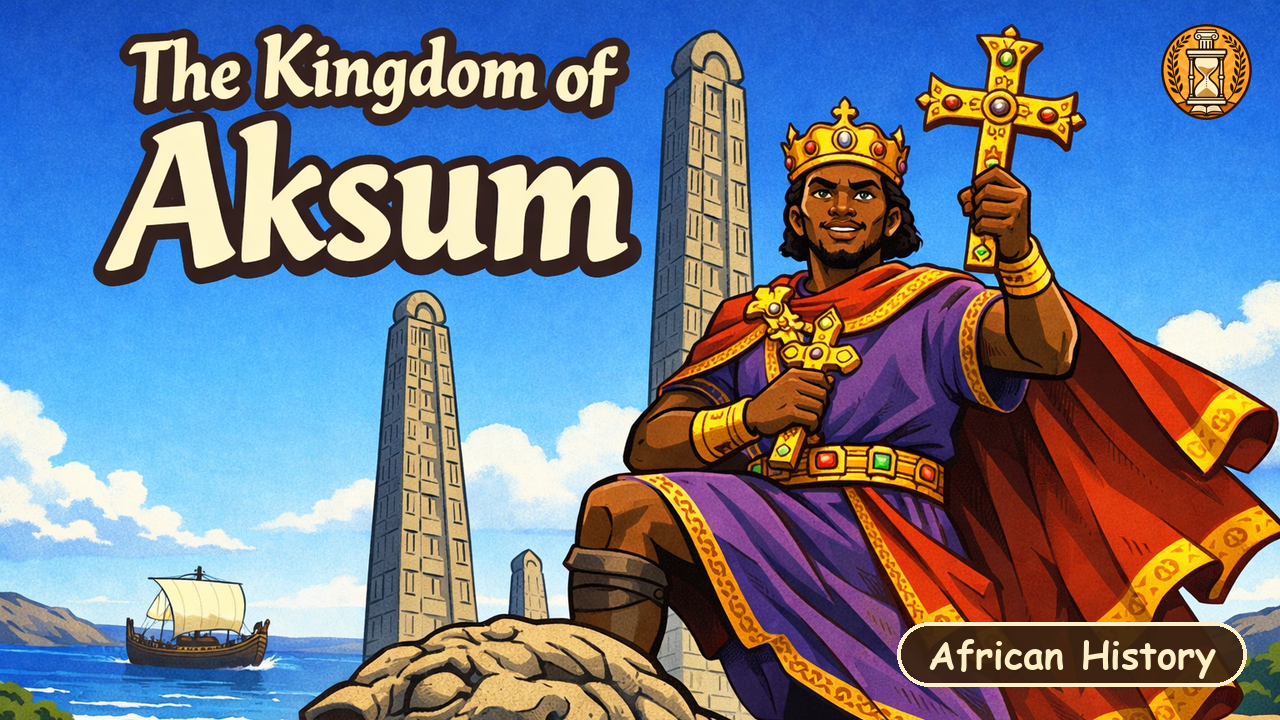
So you’ve heard of Rome, Athens, and maybe even Carthage. But have you heard of the ancient superpower that planted giant needles in the ground and gave the world a new religion’s best friend? Buckle up for the Kingdom of Aksum, the OG Ethiopian empire that made the Red Sea its personal swimming pool.
The Startup That Became a Superpower
Imagine the 1st century CE. The Roman Empire is flexing, but down in the Horn of Africa, a scrappy trading post is about to IPO. Aksum started as a modest hub where merchants from Egypt, Arabia, and India would meet to swap ivory, gold, and spices. It was the ancient equivalent of a rest stop that somehow became Silicon Valley.
King Zoskales, the first ruler we actually know about, was described by a Greek sailor as a guy who “knows Greek” — which, in the ancient world, was like having a LinkedIn profile. Under him and his successors, Aksum didn’t just participate in trade; it dominated it. By the 3rd century, this kingdom was minting its own gold coins (showing off, honestly) and was listed alongside Rome, Persia, and China as one of the four great powers of the era. Not bad for a place that started as a caravan pit stop.
Giant Needles and Divine Vibes
If you visit Aksum today, you’ll see the Great Stelae — towering granite obelisks, the tallest of which is over 80 feet and weighs as much as a fully loaded Boeing 737. These weren’t just for decoration. They were markers for underground tombs, meant to show the world, “Our king is dead, and he was very important.”
Construction was a logistical nightmare. Quarrying, carving, and dragging these monoliths without trucks or cranes? That’s the ancient version of assembling IKEA furniture with no instructions and a hangover. The stelae were so iconic that when Aksum later adopted Christianity, they didn’t tear them down — they just added a church nearby. Repurposing, baby.
Speaking of Christianity: Aksum became one of the first states in the world to officially adopt it, way back in the 4th century. King Ezana made the switch, and unlike some empires that forced it on people, Aksum just… did it. The result? A unique blend of Jewish, Christian, and local traditions that still shapes Ethiopian identity today.
King Kaleb, the Red Sea Boss, and the Plot Twist Called Islam
By the 6th century, King Kaleb was throwing his weight around. He launched a military expedition across the Red Sea to Yemen, to protect Christians from persecution. It worked, but here’s the thing: no one asked Aksum to be the Middle Ages’ police force. They got stuck with the bill.
Then came the 7th century and the rise of Islam. Suddenly, the Red Sea trade routes that made Aksum rich were rerouted through the new Islamic caliphates. Aksum didn’t get conquered — it just got ignored. Imagine a mall anchor store when the new mall opens across town. Foot traffic vanished.
But the real killer wasn’t the competition; it was the soil. Aksum’s population boomed, and they needed wood for smelting iron and building ships. They deforested like it was going out of style. Without trees, the land eroded, the fields went barren, and the empire slowly starved. Environmental degradation: the ultimate empire-killer, and we’re still ignoring it.
The Queen Who Broke It All
The final nail in the coffin came in the 10th century with Queen Gudit (or Yodit, if you’re nasty). Legends say she was a Jewish queen from the south who marched on Aksum, sacked the city, and burned the churches. Some stories claim she was rejected by the royal family, so she decided to make it everyone’s problem. Petty? Maybe. Effective? Absolutely.
After Gudit, Aksum was a shadow. The capital moved south, the trade vanished, and the stelae became overgrown relics. But here’s the twist: Aksum didn’t die. It became Ethiopia. The Solomonic dynasty, the Ark of the Covenant (allegedly hidden in a chapel there), and the Ethiopian Orthodox Church all trace their roots to this ancient kingdom.
So, what’s the takeaway? Aksum was a civilization that did everything right — trade, monoliths, early adoption of Christianity — until it did one thing wrong: it forgot that trees are kind of important. And when Queen Gudit came knocking, there was no canopy left to hide under. Remember, folks: sustainability isn’t just a buzzword; it’s the difference between empire and archaeology.
Chapters
- 0:00 — Introduction
- 0:14 — The Setting
- 0:23 — Rise of Aksum
- 0:57 — Periplus mentions Aksum
- 1:41 — Stelae construction
- 2:20 — Endubis mints coins
- 2:57 — Ezana’s conversion
- 3:32 — Conquest of Meroë
- 4:28 — Aksum as Christian state
- 5:04 — Trade with Byzantium
- 5:15 — On the Move
- 5:19 — Trade with Byzantium
- 6:04 — Kaleb’s campaign
- 6:40 — Fall of Zafar
- 7:21 — Abraha’s rebellion
- 8:12 — Elephant incident
- 9:03 — Decline of Aksum
- 9:53 — Last coins of Armah