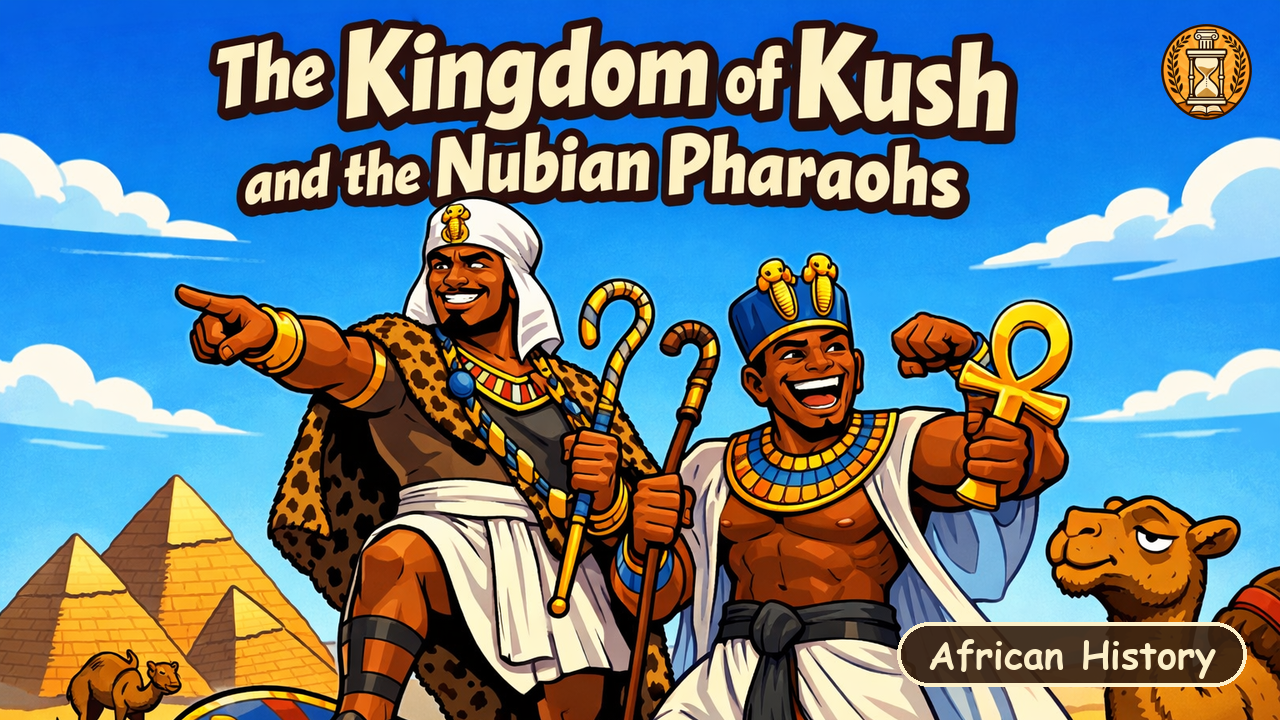
Forget everything you know about ancient Egypt’s “mysterious” hieroglyphs and golden death masks. For a glorious half-century, the guys running the show weren’t even Egyptian. They were the Kushites—the Black Pharaohs—and they showed up, conquered the Nile Valley, and then had the audacity to be more traditional than the people they conquered.
## The Original Powerhouse: Kerma (Or, “Egypt, We Were Here First”)
Long before Rome was a rumor and before the pyramids at Giza were even a tourist trap, the Kingdom of Kush was already flexing. Around 2500 BCE, the city of Kerma, deep in modern-day Sudan, wasn’t just a village with a nice river view. It was a bustling, wealthy empire with massive mud-brick temples, elite tombs, and enough gold to make a pharaoh jealous. The Egyptians called this region “wretched Kush” in their inscriptions, which is exactly what you call a neighbor who is richer than you and refuses to lend you a cup of sugar. For centuries, Egypt and Kerma traded, fought, and traded some more, like two grumpy roommates sharing the same bathroom (the Nile).
## The Egyptian Takeover and the Napatan Pivot
But then, Egypt got its act together—or, more accurately, got its military boots on. During the New Kingdom (c. 1500 BCE), Egypt colonized Nubia, burned Kerma to the ground, and built temples to their own gods on Kushite land. Talk about a hostile takeover. The Kushites, being pragmatists, didn’t just sulk. They packed up their royal court, relocated further south to Napata, adopted Egyptian writing, religion, and even the fancy headdresses. For centuries, they were the ultimate “understudy” civilization—perfectly fluent in Egyptian culture, but stuck in the colonial backstage. Then, Egypt got weak. And Kush got ideas.
## Piye’s Power Move: The 25th Dynasty (747 BCE)
Imagine the quiet, stoic student in the back of the class suddenly deciding to run for class president. That’s Piye. In 747 BCE, the King of Kush looked north, saw Egypt splintered into petty warlords, and decided to “restore order.” His invasion wasn’t a chaotic barbarian raid; it was a deeply pious, bureaucratic conquest. He marched his army down the Nile, accepted the surrender of city after city, and when he captured Memphis, he didn’t loot it—he made sacrifices to the god Ptah. He was so respectful that his opponents basically surrendered out of sheer confusion. He founded the 25th Dynasty, ruling over a united Egypt and Kush. He and his successors—Shabaka, who moved the capital to Thebes, and the long-reigning Taharqa—didn’t just sit on the throne. They actively revived ancient Egyptian art, architecture, and religious texts that had gone out of fashion. The Kushites were the hipsters of antiquity: they brought back the old stuff, made it cool again, and ruled with a piety that made the natives look like slackers. They even installed their own sister, Amenirdis I, as the “Divine Adoratrice” of Amun—the highest religious office a woman could hold—making her the queen-priestess of a political dynasty.
## The Assyrian Reckoning and the Meroë Legacy
Alas, all good imperial gigs must end. The Assyrian Empire, with its iron weapons and a serious lack of patience for “traditional revivals,” came knocking. After a series of brutal sieges, Taharqa and his successor were driven back south. By 656 BCE, the Kushites were expelled from Egypt, retreating to their homeland like a kicked-out houseguest with a lot of baggage. But they didn’t disappear. The Kushites simply moved their capital further south to Meroë, where they built over 200 pyramids—smaller, steeper, and arguably more charming than the Egyptian ones—and continued to rule for another 1,000 years. They got so independent that they eventually abandoned Egyptian hieroglyphs for their own Meroitic script, and by the time Rome showed up, the Kushites were the only empire on Earth that could negotiate with them as equals. They even reportedly sent a severed Roman general’s head back to Meroë as a souvenir.
So, the next time you see a pyramid, don’t just think of Cleopatra. Think of the Black Pharaohs—the conquerors who came to restore, stayed to revive, and left a legacy so durable that Rome had to play nice.
Lesson learned: never underestimate the “understudy.” They might just rewrite the whole script.
Chapters
- 0:00 — Introduction
- 0:40 — Egyptian Conquest
- 0:56 — The Ground
- 1:00 — Egyptian Conquest
- 1:10 — Kushite Resurgence
- 1:28 — On the Move
- 1:32 — Piye’s Campaign
- 2:06 — Piye’s Victory
- 2:39 — Shabaka’s Conquest
- 3:33 — Taharqa’s Building
- 4:04 — Assyrian Invasion
- 4:45 — Kushite Retreat
- 5:15 — Capital Moves to Meroë
- 5:42 — Meroë’s Golden Age
- 6:22 — Roman Conflict
- 6:47 — Petronius’ Campaign
- 7:28 — Peace Treaty
- 8:04 — Meroë’s Decline
- 8:24 — Aksumite Invasion
- 8:53 — Legacy of Kush