
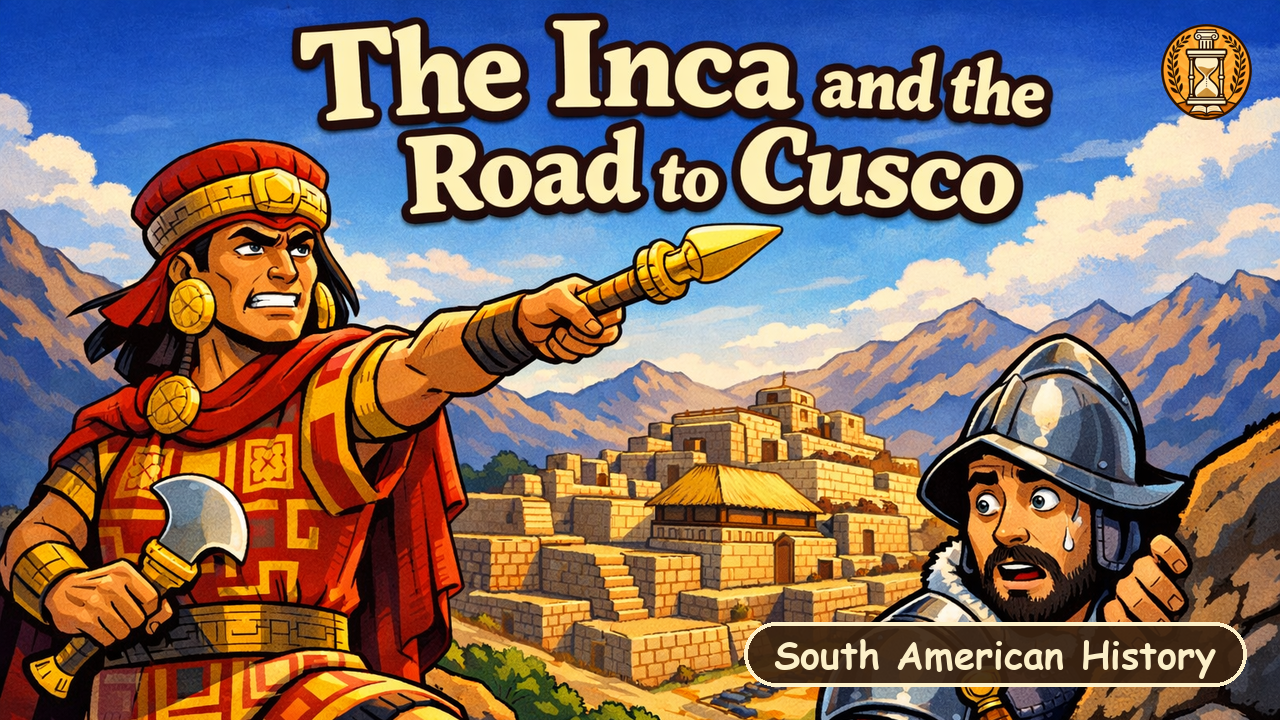
Imagine a startup that begins in a tiny valley, scales to dominate a continent, builds its own superhighways, and then gets bought out by a rival with better weapons and worse PR. That’s the Inca Empire, minus the venture capital and plus a lot of llamas.
The Underdog Gambit: Don’t Mess with the Chancas
Every empire needs a founding myth, but the Inca got a battle instead. By the early 15th century, Cusco was a decent-sized city-state, but hardly the boss of the Andes. Then the Chancas—a rival group with a serious grudge—showed up with an army and demanded the city surrender. The reigning Sapa Inca, Viracocha Inca, took one look at the situation and decided to evacuate, like a manager leaving a sinking ship via the fire escape. He even named his son Urco as heir, which was about as inspiring as a soggy cracker.
But his other son, Pachacuti, had other plans. While dad ran, Pachacuti rallied the troops, the priests, and probably a few angry farmers with slings. At the Battle of Yahuarpampa (literally “Field of Blood,” which tells you everything), Pachacuti’s scrappy forces pulled off an upset that would make any sports analyst weep. The Chancas broke, and Pachacuti didn’t just win the battle—he won the crown. Viracocha and Urco came back, but Pachacuti was now the Sapa Inca, and he had a to-do list longer than the Andes themselves.
The Great Renovation: Sacsayhuamán and the Qhapaq Ñan
Pachacuti wasn’t content with just a victory parade. He rebuilt Cusco in the shape of a puma, because why not, and then started on Sacsayhuamán, a fortress of megalithic stones so perfectly fitted that you can’t slide a credit card between them. (The Inca didn’t have credit cards, but you get the point.) It was part temple, part bunker, part “look what we can do.”
But the real genius was the Qhapaq Ñan—the Great Road Network. Imagine a 40,000-kilometer highway system that crosses deserts, jungles, and mountains, with rope bridges swinging over chasms. It made Rome’s roads look like a suburban cul-de-sac. This wasn’t just for sightseeing; it was the empire’s nervous system, moving armies, messages, and chicha corn beer faster than you can say “logistics.” And with terraced farming carved into every hillside, they fed millions on land that would make a modern farmer weep. It was agriculture as engineering, and it worked.
The Expansion Pack: From Chimú to Huayna Capac
Pachacuti, now the GOAT, handed the keys to his son Topa Inca Yupanqui, who did the heavy lifting. Topa marched north and crushed the Chimú civilization, a wealthy coastal rival. Their leader, Minchancaman, probably expected a negotiation; instead, he got a one-way ticket to Cusco as a hostage. The empire ballooned, stretching from modern-day Colombia to Chile.
By the reign of Huayna Capac, the Inca were at their zenith—a million square kilometers, 12 million subjects, and a bureaucracy that used knotted cords (quipus) as spreadsheets. But Huayna Capac made a classic mistake: he died. Worse, he died during a smallpox epidemic (introduced by Europeans who hadn’t even arrived yet—talk about a drive-by). He left two sons: Huáscar and Atahualpa, who immediately started a civil war that made the Hatfields and McCoys look polite. Meanwhile, their generals, like the ruthless Quizquiz, were busy making sure the empire was too distracted to notice the Spanish ships on the horizon.
The Final Audit: Pizarro, The Last Holdout, and the End
Enter Francisco Pizarro and Diego de Almagro, a pair of Spanish conquistadors with more ambition than morals. They showed up in 1532, found Atahualpa fresh off defeating Huáscar, and pulled off the greatest con in history: capture the emperor, demand a room full of gold, take the gold, and execute him anyway. The empire, already fractured, collapsed into chaos. The Spanish installed puppet rulers, but one, Manco Inca, escaped and led a rebellion from the jungle redoubt of Vilcabamba. For decades, a rump Inca state held out, a tiny ember of resistance.
Finally, in 1572, the last emperor, Túpac Amaru, was captured and beheaded in Cusco’s main square. The empire was done. The roads fell into disrepair, the terraces grew wild, and the only thing left was the legend. But here’s the kicker: the Inca built so well that his descendants still farm those terraces today, and the Qhapaq Ñan is now a UNESCO World Heritage site. They lost the empire, but they won the long game.
So the next time you see a perfectly stacked dry-stone wall, raise a glass of chicha to Pachacuti—the guy who turned a retreat into a superpower, one blood-soaked field at a time.
Chapters
- 0:00 — Introduction
- 0:15 — The Setting
- 0:25 — Pachacuti Defeats Chanca
- 0:49 — Rebuilding Cusco
- 1:21 — Road Network Begins
- 1:59 — Topa Inca Conquers North
- 2:33 — Huayna Capac Expands South
- 2:52 — Empire at Its Peak
- 3:12 — Huayna Capac Dies
- 3:38 — Civil War Begins
- 4:07 — Atahualpa Victorious
- 4:40 — Pizarro Lands in Tumbes
- 5:16 — Atahualpa at Cajamarca
- 5:28 — On the Move
- 5:32 — Atahualpa at Cajamarca
- 5:58 — Ambush at Cajamarca
- 7:07 — Ransom of Atahualpa
- 7:49 — Execution of Atahualpa
- 8:29 — March to Cusco
- 9:01 — Manco Inca Installed

