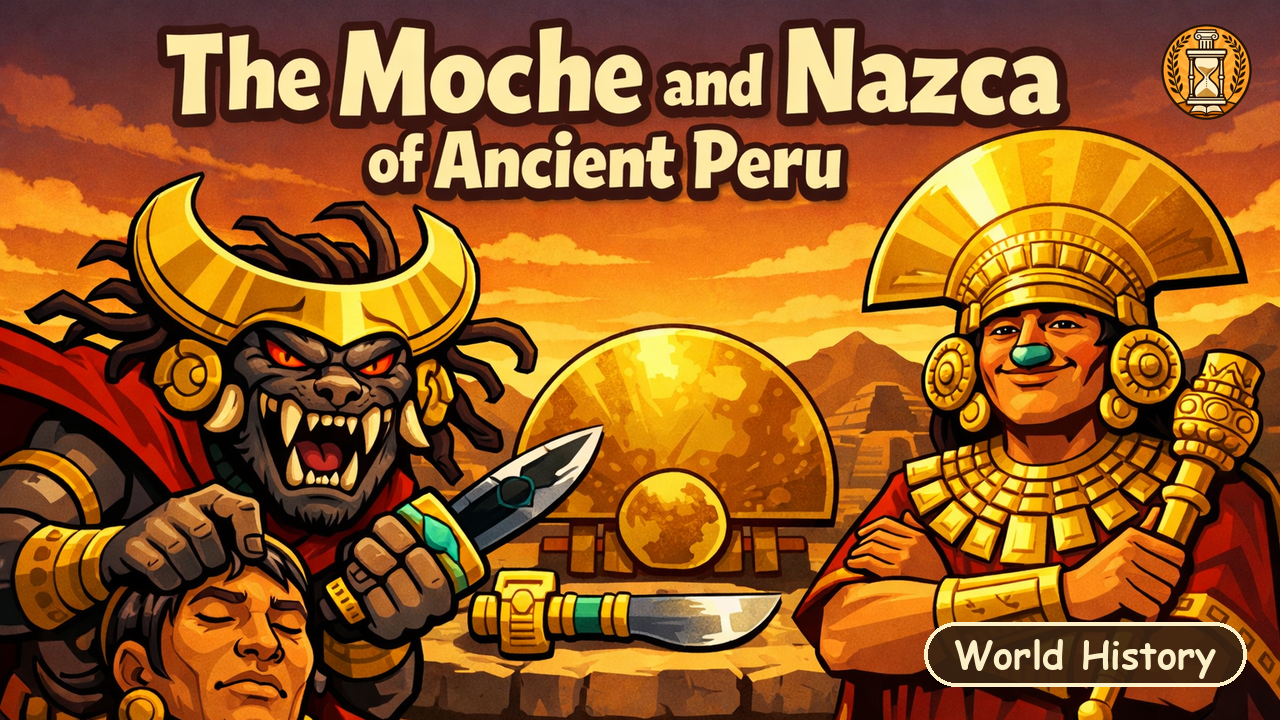
Archaeology’s greatest hits are usually pyramids, gold, and blood, but ancient Peru’s coastal double-feature—the Moche and the Nazca—served up all three, plus a side of geometric spaghetti that still confuses the GPS on your phone.
The Moche: Blood, Gold, and Very Fancy Pots
If you think your HOA is strict, try being a Moche artisan. These folks, who thrived from roughly 100 to 800 CE in the river valleys of Peru’s north coast, didn’t just make pottery—they perfected the stirrup-spout pot, a vessel with a spout shaped like a stirrup that looks like a ceramic bong designed by someone who’d never seen a horse. But don’t let the whimsy fool you. They used these pots to store chicha (corn beer) and to immortalize everything from llamas to anthropomorphic sea creatures with unsettlingly human faces.
Their metalwork was equally absurd. Moche smiths gilded copper with a technique so advanced that Spanish conquistadors later assumed the stuff was solid gold—only to realize it was a “gold-plated” scam centuries before anyone invented the term. And their art? It’s basically the world’s oldest medical textbook, with ceramic depictions of surgeries, amputations, and even childbirth, often with the patient looking remarkably serene for someone about to get a trepanation (that’s a hole in the skull, for the uninitiated).
The Huacas: Where the Party Ends
The Moche’s spiritual center was a pair of giant mud-brick mounds called the Huaca del Sol and Huaca de la Luna. The Huaca del Sol was the largest adobe structure in the Americas—a colossal step pyramid that took millions of bricks to build. But the Huaca de la Luna was the real hotspot, because that’s where the warrior-priests held their elite rituals. And by “rituals,” I mean “mass human sacrifice.”
Here’s where the Moche get dark. In ceremonial events that would make a horror movie director blush, warrior-priests would capture prisoners, ritually drink their blood, and then decapitate them, stacking the bodies in courtyards. The evidence is chilling: dozens of skeletons, some with cut marks on the neck and ribs, all buried in mud during torrential El Niño rains. It’s like a very grim Thanksgiving, but with more llamas and less turkey.
The Nazca: Lines, Toilets, and Aqueducts
Meanwhile, a few hundred kilometers south, the Nazca culture (c. 100 BCE–800 CE) was doing something completely different: drawing massive pictures in the desert that you can only see from an airplane. The Nazca Lines are geoglyphs—hummingbirds, monkeys, spiders, and triangles—etched by removing the dark topsoil to reveal the lighter sand beneath. They’re so large that they’re basically prehistoric skywriting for gods, and they’ve spawned more conspiracy theories than a UFO convention. But the most likely explanation is ceremonial: astronomer-priests and Nazca priests probably walked along the lines in ritual processions, aligning them with the heavens, rain, and mountain deities. It’s a sacred pilgrimage route, except instead of a gift shop, you get a sun-scorched plateau.
But the Nazca weren’t just artists—they were engineers. To survive in one of the driest deserts on Earth, they built the puquios, a network of spiral wells and underground aqueducts that channeled groundwater into the fields. These aren’t just ditches; they’re cleverly designed “hand-dug” tunnels that still function today. Think of them as ancient smart irrigation, minus the smartphone.
A Tale of Two Deserts
So, what made these two cultures tick? It’s all about the environment. The Moche had fertile river valleys but faced catastrophic climate swings from El Niño, which likely fueled their bloodthirsty rituals—a desperate attempt to appease angry gods. The Nazca, on the other hand, lived in a hyper-arid zone, so they channeled their obsession into water management and celestial mapping. One culture built pyramids to sacrifice people; the other built aqueducts to sacrifice boredom. Both left behind masterpieces that make our modern murals look like doodles in a middle-school notebook.
In the end, the Moche and Nazca remind us that civilization is less about progress and more about adaptation—and that if you’re going to be wiped out by a climate event, you might as well leave behind some killer pottery and an airport-worthy runway.
And if you ever find yourself walking the Nazca Lines, remember: they were made for the gods, not for your drone footage.
Chapters
- 0:00 — Introduction
- 0:18 — Moche Metalwork
- 0:48 — Moche Sacrifice Ritual
- 1:20 — Lord of Sipán
- 1:48 — Moche Decline
- 2:28 — Nazca Emergence
- 3:03 — Nazca Lines Creation
- 3:32 — Puquios Construction
- 4:01 — Cahuachi Ceremonies
- 4:33 — Nazca Textiles
- 4:53 — On the Move
- 4:56 — Nazca Textiles
- 5:06 — Nazca Pottery
- 5:38 — Nazca Elite Burials
- 6:11 — Nazca Decline
- 6:34 — The Ground
- 6:38 — Nazca Decline
- 7:12 — Wari Influence
- 7:50 — Rediscovery
- 8:31 — Sipán Excavation