
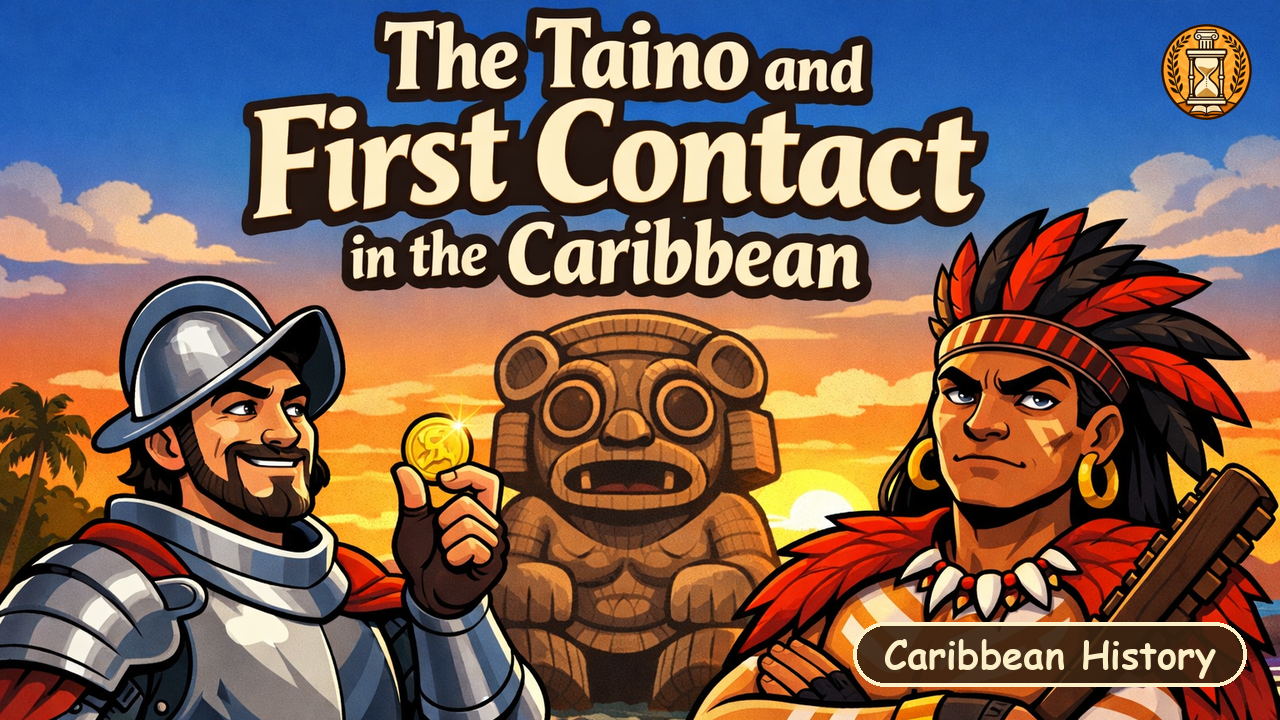
Somewhere around 1200 CE, a group of people paddled north from South America in dugout canoes, looked at the Caribbean’s turquoise water, and thought, “Yeah, we’ll take it.” They didn’t know they were about to become the answer to a trivia question: Who had the absolute worst Tuesday in 1492?
The OG Islanders: More Than Just Hammocks
Before Columbus showed up like an uninvited guest at a housewarming, the Taino had built a civilization that was genuinely impressive. They didn’t have skyscrapers or a stock exchange, but they did have cacicazgos—a political system basically run by a head honcho called a cacique. Think of it as a medieval kingdom, but with better beach access and fewer suits of armor.
Their farming was the real flex. Instead of wrecking the soil, they built conucos—raised mounds for planting—and grew cassava, a root vegetable so versatile it could be turned into bread, and if you didn’t process it right, it was also poison. That’s not a bug; it’s a feature. They also invented the hammock, which means they beat every Western civilization to the punch on “the ultimate nap technology.”
Spiritually, they worshipped zemis—carved idols that held serious spiritual juice—and got lit at coaba ceremonies (inhaling hallucinogenic powder) followed by areyto dances, which were basically their version of a rave, complete with drum circles and ancestral storytelling. It was a good life. Then the doorbell rang.
The Worst Houseguest in History
On December 5, 1492, Christopher Columbus rolled up to Hispaniola, and the local cacique, Guacanagarix, did the reasonable thing: he threw a party. He welcomed the strangers, offered gifts, and probably hoped they’d leave after brunch. Instead, Columbus left a garrison of 39 men behind and sailed off, promising to return.
When Columbus came back in 1493, the garrison was dead, and the vibe had shifted. The Taino, led by caciques like Caonabo, had correctly deduced that these guys were not here for the cassava. Columbus, in turn, decided that diplomacy was for suckers and introduced the encomienda system—a fancy Spanish name for “you work for us forever, and we call it a favor.” It was less a social contract and more a rental agreement with no exit clause.
Caonabo fought back, got captured, and died en route to Spain. His wife, Anacaona, was a poet and a cacique in her own right, but she was also captured and executed in 1503. The Spanish were thorough, if nothing else.
The Collapse Nobody Saw Coming (But Everyone Should Have)
Here’s the part that makes historians wince: the Taino didn’t just lose a war; they were obliterated by a combination of disease, enslavement, and outright violence. Smallpox, measles, and the flu hit a population with zero immunity, and the results were apocalyptic. Estimates suggest the Taino population on Hispaniola went from around 300,000 to just a few thousand within a few decades. It wasn’t a conquest; it was a biological and social extinction event.
One Spanish priest, Bartolomé de las Casas, watched it happen and wrote it all down, which is the 16th-century equivalent of a whistleblower leaking the company emails. He spent his life arguing that the Taino were, in fact, people, not beasts of burden. It didn’t save them, but it made him the only Spanish guy at the party who didn’t look completely terrible in hindsight.
The Ghosts Who Refuse to Leave
Here’s the twist: the Taino didn’t fully vanish. Their DNA is all over the modern Caribbean, and their words survived too. Barbecue, hammock, hurricane, cannibal, and tobacco all come from Taino languages. Every time you light up a grill or nap in a hammock, you’re speaking the language of the people who met Columbus and lived to tell the tale—well, some of them did.
Modern Puerto Ricans, Dominicans, and Cubans are increasingly claiming Taino ancestry, and archaeologists are finding that the “extinct” label was premature. The culture survived in food, words, and the stubborn memory of people who refuse to be footnotes.
So, the next time you’re lounging in a hammock, eating barbecue, and watching a hurricane report on TV, just remember: you’re living in the legacy of the first Americans to get colonized. And they did it with better style and worse luck than anyone since.
The Taino didn’t disappear; they just learned to speak Spanish and keep the receipts.
Chapters
- 0:00 — Introduction
- 0:19 — The Setting
- 0:29 — Columbus arrives in the Caribbean
- 0:51 — Taino society flourishes
- 1:22 — Taino mythology and religion
- 2:09 — Columbus returns and finds La Navidad destroyed
- 3:04 — Spanish enslavement and tribute
- 3:37 — Caonabó’s resistance and capture
- 4:32 — First major epidemic
- 4:54 — Roldán’s rebellion
- 5:31 — Anacaona’s rule and Spanish encroachment
- 6:04 — Massacre of Jaragua
- 6:55 — Encomienda system and forced labor
- 7:30 — Hatuey’s resistance in Cuba
- 8:23 — Demographic collapse
- 8:57 — Enriquillo’s rebellion
- 9:40 — Taino legacy persists
