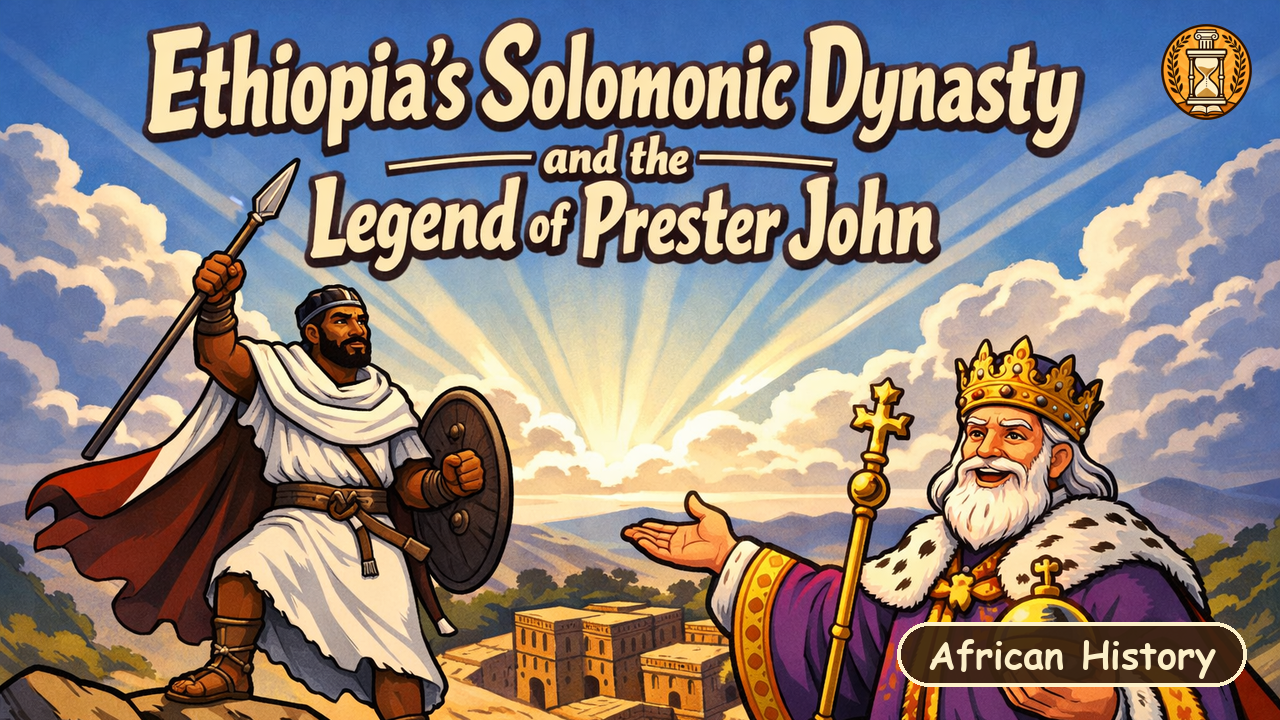
Imagine the medieval world’s most powerful rulers—kings, emperors, popes—all desperately trying to get an audience with a guy who didn’t exist. That’s the legend of Prester John, a mythical Christian king who was supposedly ruling a kingdom somewhere in Asia or Africa, and Ethiopia was just fine letting everyone believe it was him.
The Zagwe Dynasty: Rock-Solid Rulers
Long before anyone in Europe was daydreaming about Prester John, the Zagwe dynasty had seized power in the highlands of Ethiopia. They were a bit of a surprise package—not the usual royal bloodline, but they made up for it with ambition and a very particular set of skills. Their biggest flex? King Lalibela, a ruler who decided that if you want to build a church, why not carve the entire thing out of solid bedrock? No bricks, no mortar, just a mountain and a lot of patience.
Lalibela commissioned a series of rock-hewn churches, and the crown jewel was Bet Medhane Alem, the largest of them all. It’s essentially a monolithic cathedral that looks like it was beamed down from heaven, or possibly from a very ambitious quarry. The entire site became a pilgrimage destination, and to this day it’s the kind of place that makes you wonder if medieval Ethiopians were secretly wizards. The Zagwe dynasty may have been short on dynastic legitimacy, but they were long on engineering chutzpah.
The Rebel and the Restored Throne
But all good carved-out-of-a-mountain things must come to an end. Enter Yekuno Amlak, a man who looked at the Zagwe king and thought, “I’m not saying I’m better, but the throne was sort of mine first.” He rebelled, defeated the Zagwe king, and crowned himself in 1270. This kicked off the Solomonic dynasty, which claimed descent from… wait for it… King Solomon and the Queen of Sheba. It’s a lineage that’s impossible to verify, but also impossible to argue with if you’re a medieval chronicler.
The Solomonic rulers weren’t just about bloodlines; they were about brand management. Ethiopia was a Christian kingdom surrounded by Muslim states and pagan neighbors, and its rulers leaned hard into their faith as both a spiritual and political anchor. This was a Christianity that had been developing in isolation for centuries—distinctive, proud, and very much not interested in what the Pope in Rome had to say about it.
The Prester John Mix-Up
Meanwhile, back in Europe, the rumor mill was churning out the story of Prester John, a fabulously wealthy Christian monarch somewhere in the East, who was going to ally with the West against the Muslims. Emperor Frederick Barbarossa reportedly even sent envoys to find him. But nobody could locate the guy, mostly because he was a figment of medieval imagination. Still, as European explorers poked around Africa, they started to connect the dots and decided, “Hey, that Ethiopian emperor? That’s probably the guy.”
Ethiopia didn’t correct them. Why would you? It’s excellent PR. For centuries, Ethiopian rulers like Zar’a Ya’iqob played along with the myth, enjoying the attention and occasional gift from European powers. The real diplomatic action came when Emperor Lebna Dengel sent a mission to Portugal, and King Manuel I responded with muskets, cannon, and a surprisingly large number of Jesuits.
The Jesuit Problem and the Final Stand
Here’s where the story gets spicy. The Portuguese came to help, but they also came to convert. The Jesuits, backed by Rome, tried to force Ethiopian Christianity to become more, well, Roman Catholic. This went over about as well as a screenwriter telling a director they’ve got a better idea for the plot. The result was a religious and political mess, only made worse by the invasion of Ahmed ibn Ibrahim al-Ghazi—a warlord who swept through Ethiopia, aided by Ottoman firearms.
Ethiopia’s salvation came in the form of Cristóvão da Gama, son of the famous explorer, who led a Portuguese force to help. He died in the struggle, but his sacrifice, plus Ethiopian grit, turned the tide. Eventually, the invaders were pushed back, and Ethiopia remained independent—a rare feat in an age of colonization.
The Jesuits, however, overstayed their welcome. Emperor Fasilides finally had enough and expelled them in the 1630s, restoring the Ethiopian Church’s unique traditions and slamming the door on forced conversion. The legend of Prester John faded, but the reality of Ethiopia survived: a proud, uncolonized Christian kingdom that had outlasted the myth that made it famous.
The Punchline
In the end, Europe was looking for a lost Christian king, and Ethiopia let them look. But the real miracle wasn’t a mythical monarch—it was a mountain kingdom that kept its faith, its independence, and its very real rock-hewn churches, while everyone else was busy chasing a legend. Not bad for a country that never actually hosted Prester John.
Chapters
- 0:00 — Introduction
- 0:40 — On the Move
- 0:44 — Lalibela’s Vision
- 1:31 — Construction of Churches
- 2:25 — Zagwe Decline
- 3:02 — Yekuno Amlak’s Rise
- 4:00 — Battle of Ansata
- 4:36 — Solomonic Restoration
- 5:08 — The Ground
- 5:12 — Solomonic Restoration
- 5:22 — Legend of Prester John
- 6:04 — European Search Begins
- 6:42 — Ethiopian Envoys to Europe
- 7:38 — Zara Yaqob’s Reforms
- 8:10 — Portuguese Exploration
- 8:56 — Covilhã Arrives in Ethiopia
- 9:46 — Queen Eleni’s Initiative
- 11:09 — Portuguese Embassy to Ethiopia
- 12:02 — Impact of Contact
- 12:44 — Ethiopia’s Independence