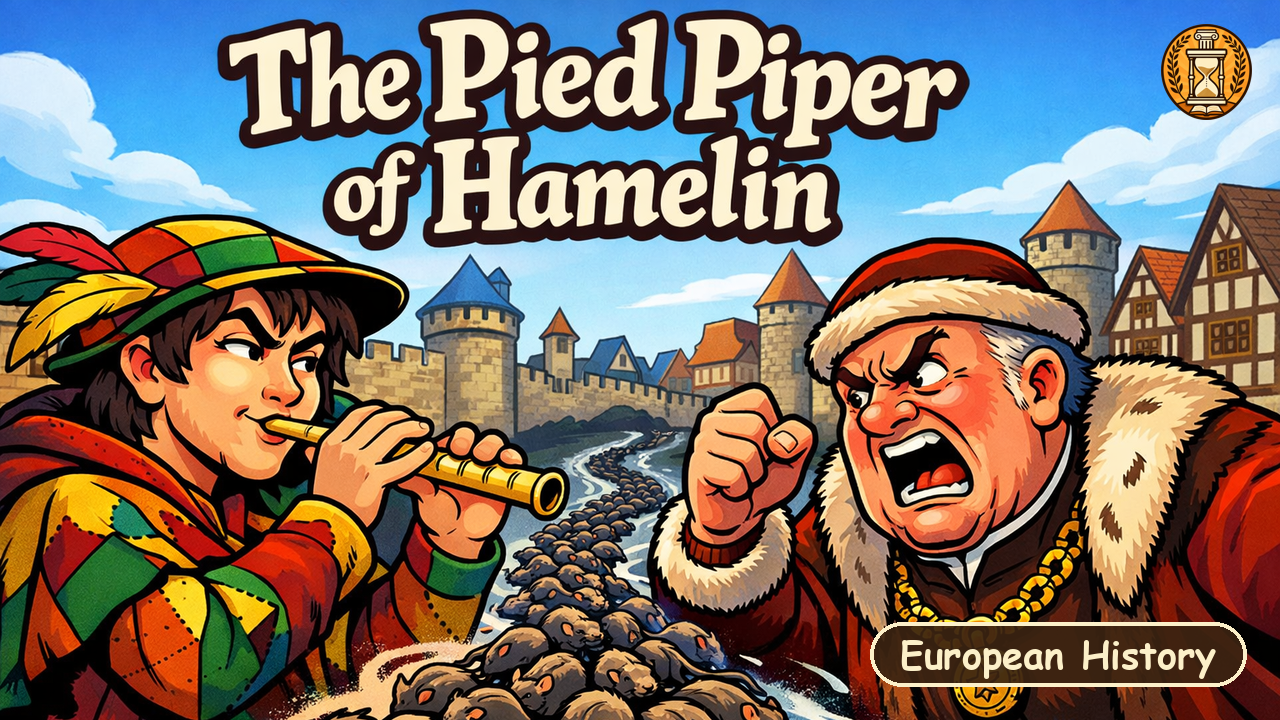
On June 26, 1284, the town of Hamelin lost 130 children. No one has ever fully explained where they went.
A Very Bad Day in Lower Saxony
The date is the one thing everyone agrees on. June 26, 1284 — a date so specific it feels like it should come with a receipt. According to local chronicles, 130 children vanished from Hamelin, a town in Lower Saxony, and the town responded the way any medieval municipality would: by writing it down and then never, ever getting over it.
The earliest surviving written account doesn’t show up until the 1440s, which means Europe spent roughly 160 years telling this story by word of mouth before anyone thought to jot it down. That’s like waiting until 1985 to first write down the plot of Star Wars. Details were bound to get fuzzy — and one detail, in particular, got very fuzzy indeed. The rats.
Rats: A Later, More Theatrical Addition
Here’s the thing nobody tells you at the puppet show: the rats aren’t in the early versions. The 1440s account describes a piper who lures the children away. That’s it. No infestation, no rodent negotiation, no unpaid invoice.
The rat plot gets bolted on later, and once it arrives, it never leaves — which is honestly a testament to rats as a narrative device. They’re the medieval equivalent of a villain with a great publicist. By the time the Brothers Grimm published their version in 1816, the full package was locked in: rats, piper, broken promise, 130 kids, one very quiet town square.
So What Actually Happened?
This is where the theories get fun. In the 19th century, historians including Ernst Ludwig Rochholz proposed the emigration theory: the children weren’t magically lured anywhere — they left. Mass migration, possibly tied to a recruiter promising land and opportunity, which is a much sadder and more believable story than a magic flute.
Modern research points toward something even more specific: a failed colonization attempt. A recruiter — the “piper” — may have gathered Hamelin’s young people for a settlement venture in the east, and it went badly. Very badly. So badly that the town memorialized it as a disappearance rather than a departure. Nothing says “we don’t talk about it” like turning your town’s worst decision into a fairy tale.
There’s also a quieter figure in the record: Johann von Soest, a 15th-century writer associated with early versions of the tale. He’s the closest thing we have to a source, and he’s about as reliable as a guy repeating a story he heard from a guy.
The Legend That Wouldn’t Leave
What makes the Pied Piper stick is that it refuses to be comforting. The Grimm tales usually end with a lesson or a wedding. This one ends with 130 empty beds and a street in Hamelin where — according to local tradition — no music is ever played. That’s not a fairy tale. That’s a wound with a melody.
So the next time someone tells you the Pied Piper is a cute story about pest control, remember: the rats were the sequel, the children were the original, and Hamelin has been trying to explain that date for 740 years.
The piper got paid in legend. Hamelin paid in something else entirely.
Chapters
- 0:00 — Introduction
- 0:33 — The Ground
- 0:37 — On the Move
- 0:41 — Piper Arrives
- 1:26 — Mayor Strikes Deal
- 1:54 — Piper Drowns Rats
- 2:36 — Mayor Refuses Payment
- 3:04 — Piper Returns for Revenge
- 3:31 — Children Follow Piper
- 4:03 — Children Vanish at Coppenbrügge
- 4:26 — Town Chronicle Records Event
- 4:49 — Stained Glass Window Erected
- 5:20 — Weyer Records Legend
- 5:51 — Grimm Brothers Publish Tale
- 6:21 — Browning’s Poem Popularizes
- 6:52 — Bungelosenstrasse Memorial
- 7:24 — Theories of Migration
- 8:02 — Plague Theory
- 8:34 — Nazi Propaganda Use
- 8:52 — Modern Hamelin Tourism