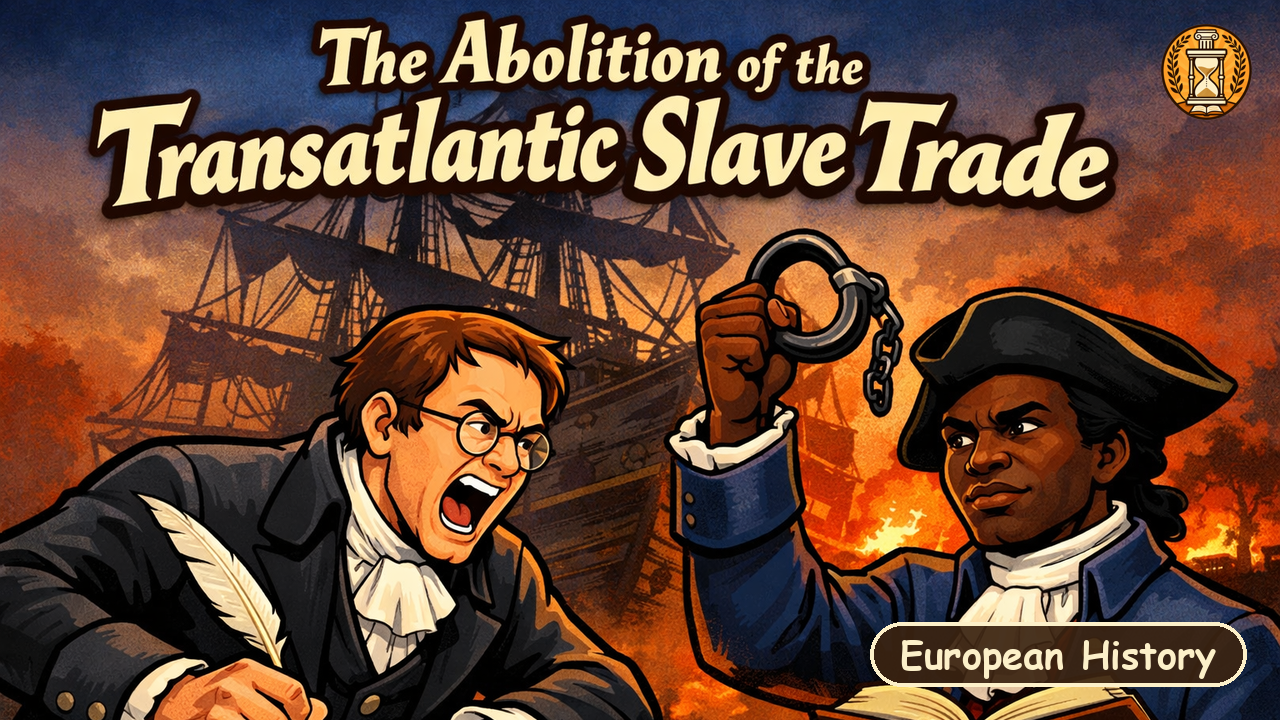
A single massacre, three stubborn men, and a revolution in the Caribbean did what a century of polite complaining could not.
The Man Who Made Murder Profitable
In 1781, the captain of the slave ship Zong threw roughly 130 enslaved Africans overboard. Not out of panic, not out of malice in the moment — out of accounting. The ship’s insurers covered drowned “cargo” but not enslaved people who died of illness aboard. So the crew chose the cheaper death.
The resulting court case, and the public outrage it stirred, became a gift to abolitionists. Granville Sharp, a lawyer who’d spent years fighting for Black freedom in English courts, seized on it. The Zong massacre didn’t end the slave trade. But it made the trade visible — and once ordinary Britons could see it, they couldn’t unsee it.
A Best-Seller, a Committee, and a Very Patient MP
In 1789, Olaudah Equiano published his autobiography — his kidnapping in Africa, the Middle Passage, his years enslaved, his eventual freedom. It sold enormously and turned an abstract horror into one man’s voice. Equiano didn’t just tell his story; he toured, lectured, and pushed.
Meanwhile, Thomas Clarkson was doing the unglamorous work: collecting testimony, evidence, and ship manifests, essentially running the world’s first serious human-rights research operation. In 1787, he and Sharp helped found the Society for Effecting the Abolition of the Slave Trade.
And then there was William Wilberforce. His strategy was simple: introduce an abolition bill. Watch it fail. Introduce it again. Repeat for roughly two decades. This is the political equivalent of refreshing your email hoping the problem resolves itself — except Wilberforce actually got somewhere.
In 1807, Parliament passed the British Slave Trade Act, banning British ships from carrying enslaved people. The following year, the US passed its own Act Prohibiting Importation of Slaves. Two empires, one year apart. Not a coincidence.
The Revolution Britain Couldn’t Ignore
Here’s the part that gets underplayed: enslaved people were never just waiting to be rescued. They resisted constantly — on ships, on plantations, in every way available. The largest and most consequential act of that resistance was in Saint-Domingue.
In 1791, the enslaved population of the French colony rose up. Over the next thirteen years, led in part by Toussaint L’Ouverture, they defeated French, British, and Spanish forces and established Haiti in 1804 — the first Black republic born of a successful slave revolt.
This terrified European powers and inspired abolitionists alike. It also made a practical argument: if the system kept producing uprisings, maybe the system was the problem. Add shifting economics — the trade was growing less central to British profit — and the political math finally tipped.
The Fine Print Nobody Mentions
Abolition in 1807 banned the trade, not slavery itself. Britain kept enslaving people in its colonies for another generation, and the US didn’t abolish slavery until 1865. Ending the trade was a milestone, not a finish line.
But it was a real one. And it happened because enslaved people resisted, survivors spoke, researchers documented, and one MP refused to stop introducing the same bill.
Sometimes history moves because someone loses an argument twenty times in a row.
Chapters
- 0:00 — Introduction
- 0:49 — Equiano Publishes Narrative
- 1:35 — Wilberforce’s First Bill
- 2:08 — Haitian Revolution Begins
- 2:59 — The Ground
- 3:03 — Sonthonax Abolishes Slavery
- 4:00 — Toussaint Joins French
- 4:27 — Napoleon Reinstates Slavery
- 4:42 — On the Move
- 4:45 — Leclerc’s Expedition
- 5:18 — Haiti Declares Independence
- 5:50 — Wilberforce’s Bill Passes Commons
- 6:27 — Slave Trade Act 1807
- 7:01 — U.S. Bans Slave Trade
- 7:38 — Sierra Leone Settlement
- 8:15 — Equiano’s Death
- 8:47 — Abolition Society Founded
- 9:22 — Brookes Diagram Published
- 9:49 — Wilberforce’s Persistence
- 10:36 — Haiti’s Impact on Abolition