Okay, let’s set the DeLorean for 7th-century Sumatra, where the wifi is bad but the spices are phenomenal. Forget your global superpowers for a second; the real movers and shakers were two seafaring empires who understood that controlling a narrow strip of water is the original “location, location, location.”
The OG Toll Booth of the Indian Ocean
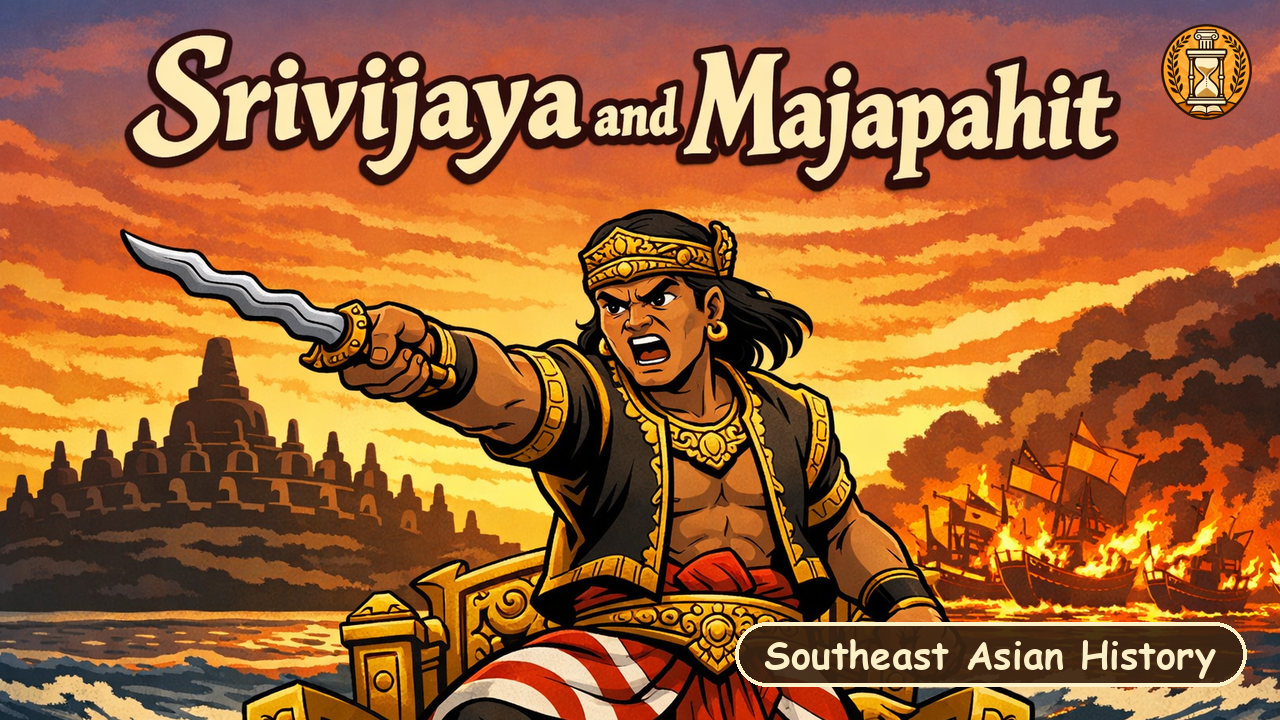
Imagine the Strait of Malacca as the world’s busiest highway, except the cars are giant wooden ships laden with silk and cinnamon, and the toll booth is a Buddhist kingdom with a serious navy. That’s Srivijaya (7th-13th century). They didn’t build giant walls or conquer vast lands; they just sat at the perfect choke point and said, “That’ll be 20% of your cargo, please.” Their naval patrols didn’t just fight pirates; they were the AAA roadside assistance of the ancient maritime world, ensuring safe passage for traders—for a fee, naturally.
This strategy worked so well that a Chinese Buddhist pilgrim named I-Tsing decided to stop for a study break in their capital, Palembang, in 671 CE. He wasn’t there for the beach. Srivijaya had become a booming center for Buddhist scholarship, translating texts and hosting monks like a medieval Ivy League with a tropical campus. King Jayanasa—a name that sounds like a D&D character—was the CEO of this operation, and business was booming.
A King, a Prime Minister, and a Really Big Oath
Fast forward a few centuries. Srivijaya fades, and the torch (or perhaps the spice grinder) passes to Majapahit (13th-16th century). Their empire was the ultimate power move of the era, and it all started with a dramatic speech. Their ambitious prime minister, Gajah Mada, swore the Palapa Oath: he would not taste any spices (or food, the texts are a little fuzzy on the seasoning) until he had united the entire archipelago under Majapahit’s rule.
That’s commitment. It’s like a CEO refusing to drink coffee until the quarterly earnings report is flawless. And he pulled it off. Under King Hayam Wuruk (a name that sounds like a fancy bird, but he was the boss), Gajah Mada led conquests that brought Bali and even the old Srivijaya stronghold of Malacca to heel. This wasn’t just for glory; it was for the spice monopoly.
The Spice Must Flow
Here’s where it gets delicious. Majapahit didn’t just control land; they controlled the source of the world’s most valuable commodities. Nutmeg, cloves, and pepper were the oil of the 14th century. By monopolizing the spice trade, they didn’t need to invent anything; they just needed to own the supply chain. Their ports became the world’s most exclusive grocery stores, and they were the only ones with the keys.
This economic dominance meant their culture, a vibrant blend of Hinduism and Buddhism, was exported along with the pepper. They built grand temples, developed a sophisticated court culture, and basically became the coolest kids in the region. Their legacy is so potent that modern Indonesia looks back on Majapahit as a foundational golden age—the historical equivalent of claiming your high school band was actually the greatest rock group ever.
The Ghosts of Golden Ages
So what’s the takeaway from these two maritime giants? They prove that in history, you don’t need to be the biggest to be the most powerful. You just need to be the most strategically annoying. They controlled the straits, they controlled the scholarship, and they controlled the nutmeg. Their rise and fall were tied to the winds of trade and the whims of ambitious men with catchy titles.
They left behind a legacy that’s part history, part national myth—a reminder that for centuries, the beating heart of the global economy wasn’t in Rome or Beijing, but on a bunch of humid, spice-scented islands in Southeast Asia. Now, if only they’d invented a better air conditioner, they might have conquered the world.
Chapters
- 0:00 — Introduction
- 0:16 — The Setting
- 0:25 — Srivijaya Founded
- 0:50 — Srivijaya Controls Strait
- 1:09 — I Tsing Studies
- 1:48 — Balaputradewa’s Reign
- 2:18 — Srivijaya Decline
- 3:07 — Singhasari Rises
- 3:51 — Mongol Invasion
- 4:27 — Raden Wijaya’s Alliance
- 4:55 — Majapahit Founded
- 5:29 — Gajah Mada’s Oath
- 6:00 — Conquest of Bali
- 6:31 — Hayam Wuruk’s Reign
- 7:12 — Nagarakertagama
- 7:49 — Gajah Mada’s Death
- 8:26 — Civil War
- 8:47 — The Ground
- 8:52 — Malacca’s Rise
- 9:26 — Majapahit Decline