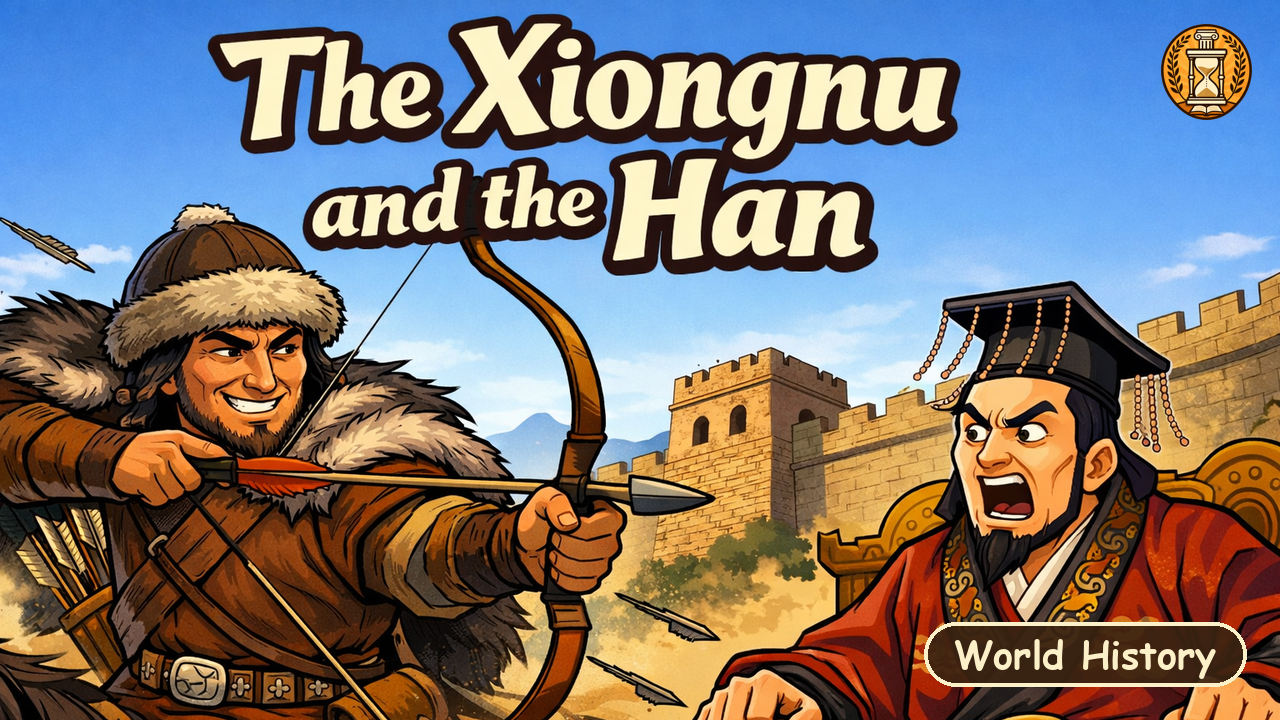
Picture Rome and Carthage, except one of them rides horses really well and the other invented paperwork. For three hundred years, the Xiongnu and the Han Dynasty fought a war that was less a clash of civilizations and more a very long, very violent argument over who got to set the terms of trade. Spoiler: it ended with one side getting a stern letter and the other getting a new postal system.
The Emperor Who Walked Into a Trap (And Bribed His Way Out)
It all started with Emperor Gaozu, the founder of the Han Dynasty. In 200 BCE, he decided to teach the Xiongnu a lesson. Modu Chanyu, the Xiongnu leader, had other plans. Gaozu marched his army straight into a classic steppe feint—luring the Han forces to Baideng, where Modu promptly surrounded them. For seven days, the emperor of China was effectively a VIP hostage in a yurt-themed siege. The escape? Not through brilliant tactics, but through bribery. Gaozu slipped gifts to Modu’s wife, who apparently whispered some very persuasive nonsense about bad omens and bothersome ghosts. The Xiongnu opened a gap in the encirclement, and the emperor bolted. Lesson learned: never go to a cavalry fight without a gift bag.
The “Peace” Treaty That Was Really a Protection Payment
After Baideng, the Han tried a new strategy: the heqin treaty. This was a diplomatic masterpiece—if your definition of masterpiece is “paying tribute to stop the raiding.” The Han sent princesses to marry Xiongnu leaders and shipped over silk, grain, and wine like they were subscribing to a very aggressive streaming service. In exchange, the Xiongnu mostly stopped setting fire to border towns. It worked for decades, but it was essentially a protection racket with a royal wedding attached. The Han nobility seethed. They were paying for peace with a credit card that never got paid off.
Emperor Wu: The Guy Who Read the Fine Print
Then came Emperor Wu, the Han ruler who looked at the heqin treaty and said, “Nah, I’d rather pay for an army.” In 133 BCE, he staged the Battle of Mayi—an elaborate ambush designed to lure the Xiongnu into a trap. It failed spectacularly when a captured officer tipped off the Chanyu, who fled just in time. But that failure was the point of no return. Wu tore up the treaty, and the Han switched from paying tribute to paying salaries for generals like Wei Qing and Huo Qubing. Wei Qing promptly captured the Ordos region, a strategic bulge of grassland that gave the Han a staging ground for cavalry raids. It was the ancient equivalent of seizing the high ground in a video game, except the respawn timer was three centuries.
The Endgame: A Civil War and a Very Satisfying Letter
The Han kept pushing, and the Xiongnu kept fighting, but by the first century CE, the confederation was cracking. A succession crisis split them into Southern and Northern factions. The Southern Xiongnu, ever pragmatic, allied with the Han. The Northern Xiongnu, ever stubborn, kept raiding. The decisive blow came from General Dou Xian, who in 89 CE launched a campaign that broke the Northern Chanyu so thoroughly that his horde scattered into the western steppe. Dou Xian marked the victory by carving a memorial into a mountain—a stone press release that essentially said, “We beat you, and we brought a geologist to prove it.” The Han didn’t just win; they made sure the victory was legible from space.
The Xiongnu didn’t vanish—they merged, migrated, and evolved—but their power was shattered. The Han had survived, not through better swords, but through better logistics, patience, and a willingness to spend absurd amounts of money on horses and fortifications. In the end, the steppe versus empire fight wasn’t about who was braver. It was about who could build a longer supply chain. The Han won, and the Xiongnu got a footnote in history. Well, that, and a very nice mountain with their defeat carved into it.
Chapters
- 0:00 — Introduction
- 0:33 — On the Move
- 0:37 — Battle of Baijiao
- 1:10 — Heqin Policy
- 1:54 — Zhang Qian’s Journey
- 2:41 — Wei Qing’s First Campaign
- 2:48 — The Ground
- 2:52 — Wei Qing’s First Campaign
- 3:09 — Huo Qubing’s Raids
- 3:48 — Battle of Mobei
- 4:21 — Death of Huo Qubing
- 5:00 — Yizhixie’s Raids
- 5:24 — Ban Chao’s Campaigns
- 6:13 — Wang Zhaojun’s Marriage
- 7:08 — Fall of the Xiongnu