He limped into history on a ruined leg, with a bow in one hand and a grudge in the other, and somehow built the most beautiful city on Earth.
The Sheep Thief Who Couldn’t Stop
Timur wasn’t born to conquer. He was born to raid, steal, and probably annoy local farmers. A minor noble in the Chagatai Khanate—a Mongol successor state that had all the political stability of a reality TV reunion—he started his career as a sheep rustler. Not exactly the stuff of epic poetry. But then came the arrow.
In his twenties, during a skirmish, Timur took an arrow to the right hand and a separate wound to the leg. The result: a permanently useless right arm and a limp so bad he’d be known forever as Timur the Lame—or, as the West would mangle it, Tamerlane. Most men would have retired to a nice, quiet life of counting stolen livestock. Timur instead decided that if he couldn’t fight properly, he’d just have to out-think everyone. Spoiler: he did.
The Alliance of Mutual Convenience (and Mutual Betrayal)
Timur’s big break came when he teamed up with a fellow warlord, Amir Husayn. Together, they raided and schemed across Central Asia, conquering Balkh and Herat. It was a beautiful partnership, the kind you see in buddy movies right before one guy destroys the other. Timur, ever the pragmatist, waited until Husayn’s popularity tanked, then besieged him, had him executed, and declared himself emir of the entire region.
To give his rule a veneer of legitimacy, he installed a puppet khan, Suyurghatmish Khan, a descendant of Genghis Khan. This was like hiring a CEO to stand in the corner while you run the company. Timur didn’t care about bloodlines; he cared about results. And his results were about to get very, very bloody.
Skull Pyramids and a City of Blue
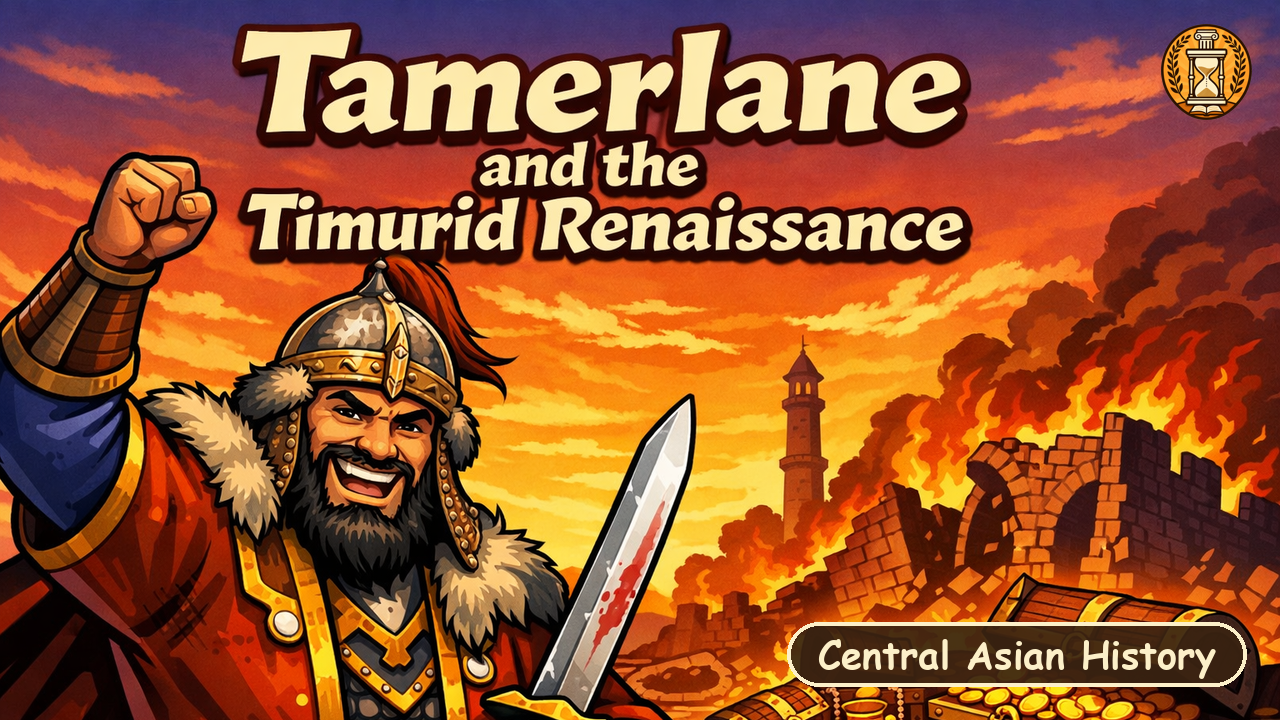
Here’s where the “sword” part of our story gets graphic. Timur was a master of terror. When the Persian city of Isfahan rebelled against his rule, he ordered the systematic execution of some 70,000 citizens. Their severed heads were stacked into neat, horrifying pyramids—a medieval warning that made the “no refunds” policy at a used car lot look generous. He crushed the Khwarezmian Empire with similar ferocity, leaving cities as ash and rivers as mud.
But here’s the paradox: this man who built monuments to death also built a monument to beauty. He decided Samarkand, his birthplace, would be the jewel of the world. He imported the best architects from Persia, the finest craftsmen from India, and the brightest scholars from everywhere. He forced the greatest minds of the conquered lands to come and live in his capital, under his watchful, one-armed gaze. The result was the beginning of the Timurid Renaissance—a flowering of astronomy, mathematics, miniature painting, and architecture that would make Florence look like a garage sale. The blue-tiled domes of Samarkand still stand as a testament to his bizarre genius.
The Kings Who Reaped What He Sowed
Timur spent his final years crushing everyone else. He defeated Tokhtamysh, the Khan of the Golden Horde, who had ungratefully rebelled after Timur helped him take power. He smashed Ahmad Jalayir of Baghdad. He even humiliated the Ottoman Sultan Bayezid I, capturing him in battle and carrying him around in a cage like a trophy parrot. He was reportedly marching on China when he died in 1405. Good timing, honestly—China would have been a hassle.
His descendants, however, were more interested in pens than swords. His grandson Ulugh Beg turned Samarkand into an astronomical observatory that mapped the stars with terrifying accuracy. Another descendant, Babur, took the family’s love of gardens and conquest and founded the Mughal Empire in India. The sword built the empire, but the pen—and the astrolabe—made it matter.
So yes, Timur was a monster. He built pyramids of skulls and left entire regions depopulated. But he also built a renaissance, proving that even the most brutal conqueror can accidentally spark a golden age. The moral? Be careful who you terrorize. Their grandchildren might write your history. Or in his case, build your tomb.
Chapters
- 0:00 — Introduction
- 0:18 — Wounded Shepherd
- 0:49 — Rise to Power
- 1:44 — Betrayal of Husayn
- 1:53 — The Ground
- 1:57 — Betrayal of Husayn
- 2:15 — Conquest of Khwarezm
- 2:32 — On the Move
- 2:35 — Conquest of Khwarezm
- 2:45 — Campaign in Persia
- 3:38 — War with Tokhtamysh
- 4:07 — Sack of Delhi
- 4:41 — Campaign in the Levant
- 5:33 — Battle of Ankara
- 6:28 — Diplomacy with Europe
- 7:13 — Return to Samarkand
- 7:54 — Death of Timur
- 8:37 — Succession Struggle
- 9:04 — Timurid Renaissance
- 9:33 — Legacy of Terror