Forget the Vikings. Forget the Phoenicians. The most influential middlemen in history didn’t sail stormy seas or sack monasteries—they haggled over silk prices in Uzbekistan and somehow ended up translating Buddhist scriptures for a living. Meet the Sogdians: history’s most successful behind-the-scenes dealmakers.
The Original Supply Chain Gurus
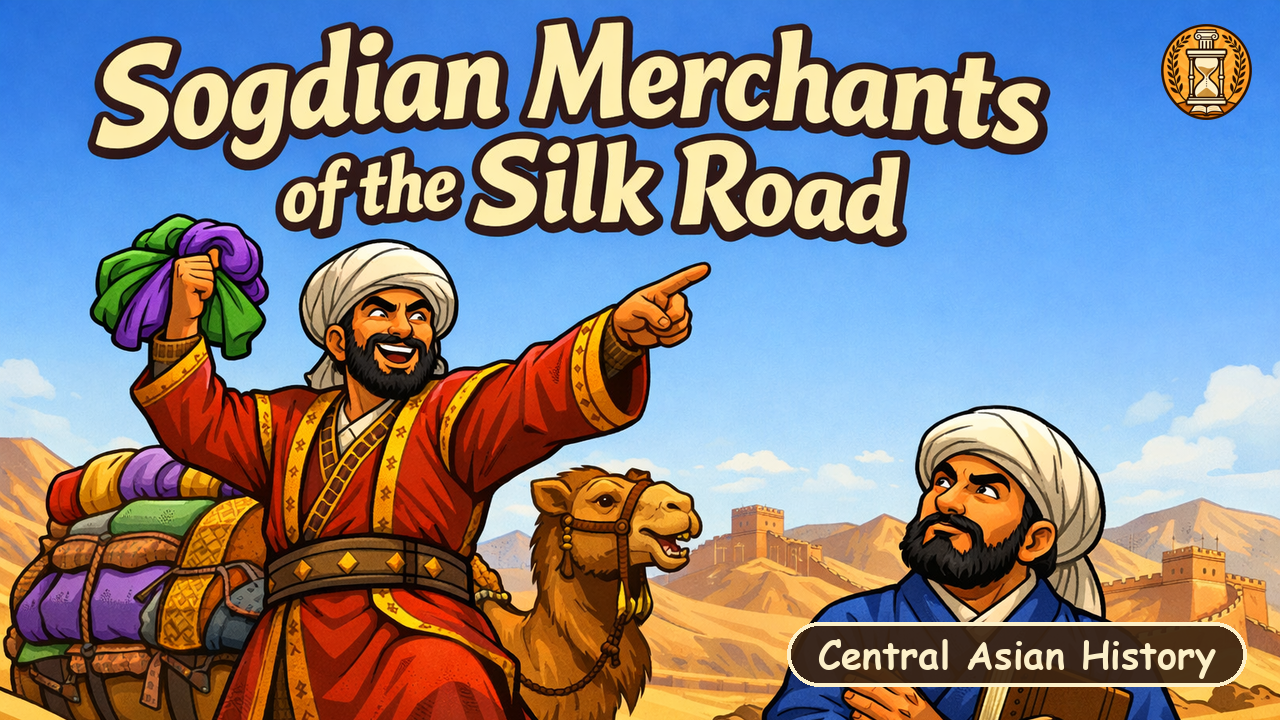
Imagine a people so good at commerce that they turned a desert into a business park. The Sogdians, a Persian-speaking group from present-day Uzbekistan, didn’t just trade along the Silk Road—they were the Silk Road. While others sold goods, they sold the routes. Their home cities, like Samarkand and Bukhara, weren’t just stopovers; they were the medieval equivalent of corporate headquarters, complete with caravans instead of cargo ships.
By the 6th century CE, Sogdian merchants had established a franchise network of trade cities stretching from China to Byzantium. They didn’t just move silk and spices; they moved ideas. When a Sogdian caravan rolled into town, it wasn’t just bringing goods—it was bringing the latest philosophical trends, a few new religions, and probably a better alphabet. Think of them as the UPS drivers of antiquity, except instead of a package, they’d hand you Manichaeism.
The Diplomatic Power Move of 568 CE
Here’s where things get juicy. Around 568 CE, a Sogdian named Maniakh—yes, that’s his real name, and yes, it sounds like a rejected Bond villain—had a brilliant idea. The Sogdians wanted to sell silk directly to the Byzantines, but the Persians (their cousins, awkwardly) were blocking the route. So Maniakh did what any savvy businessman would: he found a new partner. He marched straight to the Göktürks, a nomadic empire that controlled the northern steppes, and proposed an alliance.
The Göktürks agreed, and Maniakh led an embassy to Constantinople, where he charmed Emperor Justin II (who reportedly thought silk was grown on trees, so the bar was low). The result? A direct trade route opened, bypassing Persia entirely. The Sogdians didn’t just sell goods; they were now geopolitical matchmakers. And they did it all without a single PowerPoint presentation.
The Religious Courier Service
But here’s the real kicker: the Sogdians weren’t content with just selling stuff. They became the world’s first religious delivery service. When Buddhism needed to spread eastward, who translated the sutras? Sogdian scribes at Dunhuang, painstakingly turning Sanskrit into their own language. When Manichaeism needed a foothold, who carried it to the Uyghurs? You guessed it—Sogdians. And when the Uyghur Khagan adopted Manichaeism as a state religion around 762 CE, it was a Sogdian-style spiritual takeover.
Even their alphabet got in on the action. The Sogdian script was adapted for Uyghur, and later, that same script evolved into the Mongol script. Yes, Genghis Khan’s empire ran on a writing system that started as a merchant’s shorthand. You’re welcome, world history.
The Collapse and the Cameo
The good times ended in 712 CE when Arab armies conquered Transoxiana. The Sogdians didn’t vanish—they assimilated, converting to Islam and blending into the new Persianate world. But their legacy was weirdly persistent. A Sogdian rebel named An Lushan—who was half-Sogdian, half-Turk—nearly toppled the Tang Dynasty in 755 CE, causing Emperor Xuanzong to flee his capital. That’s right: the greatest middlemen of the Silk Road ended their story with a literal attempted coup. Talk about a customer service complaint.
By the 9th century, the Samanids had revived Persian culture in Central Asia, and the Sogdian language faded into obscurity. Modern historians like Étienne de la Vaissière and Richard N. Frye have pieced together their story from fragments—murals, letters, and a whole lot of guesswork. But their real monument is every alphabet, every religion, and every silk robe east of Persia.
The Sogdians were the original silent partners of history. They didn’t build empires, write epics, or conquer cities. They just made sure everyone else had the goods to do it—and then quietly collected the invoice.
Chapters
- 0:00 — Introduction
- 0:32 — Caravan networks
- 1:11 — An Jia’s tomb
- 1:59 — Sogdian letters
- 2:30 — Religious transmission
- 2:40 — The Ground
- 2:43 — Religious transmission
- 3:12 — Sogdian influence in China
- 3:53 — Sogdian language and script
- 4:42 — Sogdian trade in the West
- 5:20 — Sogdian colonies
- 6:05 — Sogdian military role
- 6:32 — Sogdian art and culture
- 7:11 — Sogdian decline
- 7:44 — Sogdian legacy in China
- 8:38 — On the Move
- 8:41 — Sogdian legacy in China
- 9:13 — Sogdian influence on Mongols
- 9:57 — Rediscovery of Sogdian culture
- 10:45 — Sogdian trade routes mapped