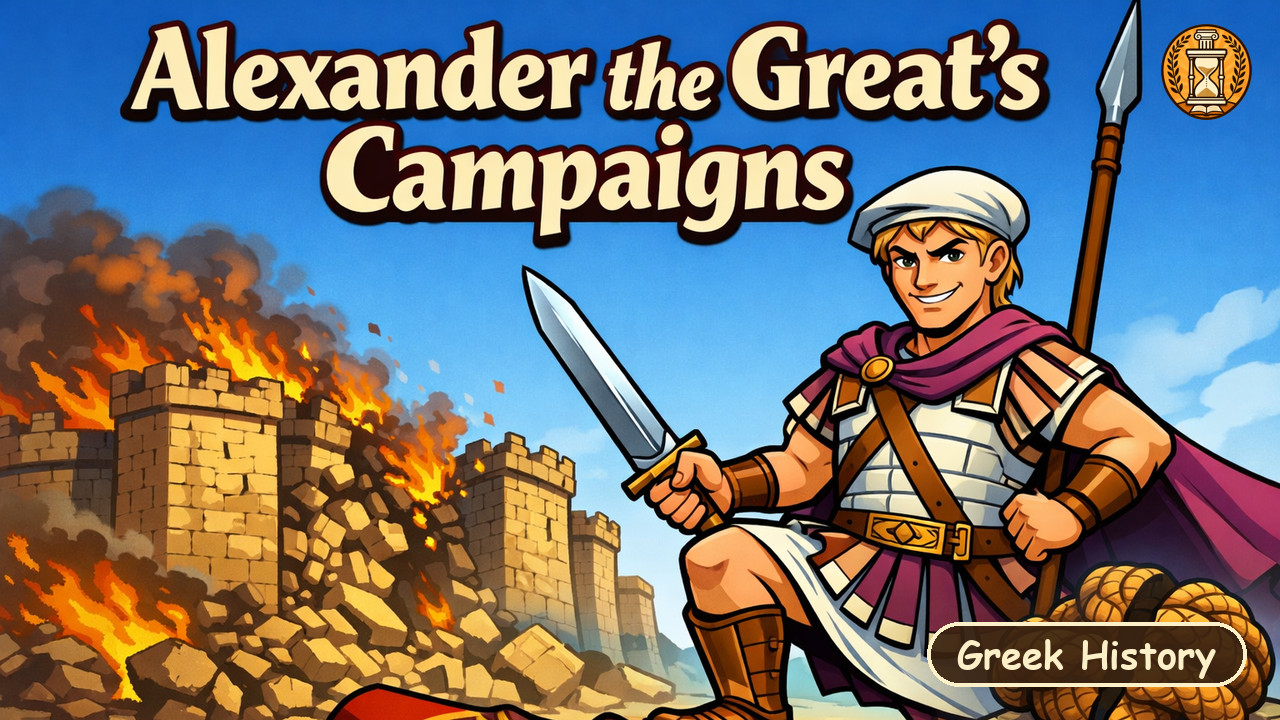
Let’s get one thing straight: Alexander the Great wasn’t called “the Great” because he remembered everyone’s birthday. He earned the title by doing something far more impressive—walking his army across three continents, winning battles that should’ve been losses, and dying before his empire’s HR department could file the paperwork. It’s a story of genius, guts, and a truly unreasonable amount of ambition.
The Hellespont Hangover
In 334 BC, Alexander—just 22, with a face that launched a thousand ships and a chin that launched a thousand coins—crossed the Hellespont from Greece into Asia. This wasn’t a casual vacation. He brought about 40,000 men, a war chest that was mostly “vibes,” and a personal copy of Homer’s Iliad he kept under his pillow. His first test came at the Battle of the Granicus River, where the Persian local governors thought they’d stop him at the water’s edge. Bad idea. Alexander led a cavalry charge across a river into spears, which sounds insane, because it was. But he won, mostly because the Persians’ best mercenary commander, Memnon of Rhodes, kept saying, “Maybe don’t fight him head-on?” and they ignored him. Memnon was right. He was always right. He died of illness a year later, which is the only thing that saved Alexander from a very annoying nemesis.
The Knot That Wouldn’t Quit
After the Granicus, Alexander rolled through Anatolia, capturing cities like Miletus in a siege that was efficient but not particularly dramatic—think of it as the office meeting before the real presentations. Then came the legendary Gordian Knot: an impossibly tangled rope tied to a cart in Gordium, with a prophecy that whoever untied it would rule Asia. Alexander, never one for patience, simply sliced it with his sword. Historians still debate whether this was genius or just “creative problem-solving” in the same way that setting your desk on fire is “creative filing.” Either way, it worked. The prophecy was fulfilled, and Alexander’s PR team had a field day.
Meanwhile, the Persian King Darius III finally showed up with a massive army. They met at Issus in 333 BC, a battle squeezed between mountains and the sea—so cramped that Persia’s numbers meant nothing. Alexander aimed his cavalry like a missile at Darius himself. The king, showing the tactical brilliance that would define his reign, fled. He left behind his family: his wife, his mother Sisygambis, and his kids. Alexander, to his credit, treated them like royalty, not hostages. Sisygambis, initially terrified, later reportedly called Alexander “her son.” That’s either Stockholm Syndrome or excellent diplomacy. Probably both.
The Big One: Gaugamela
Darius regrouped and offered Alexander a truce: marry his daughter, take all land west of the Euphrates, and go home. Alexander’s general Parmenion, a wise old veteran, said, “If I were you, I’d take it.” Alexander replied, with the smugness of a man who’d never paid taxes, “So would I, if I were you.” Then he marched to Gaugamela in 331 BC. Darius had prepared the battlefield: flat ground, cleared of obstacles, with scythed chariots that looked terrifying. Alexander responded by attacking in an oblique formation, baiting the Persians to stretch their line, then punching a hole through the middle with his Companion Cavalry. Darius fled again—this time for good. Alexander became King of Persia, and Darius was later killed by his own satrap, Bessus, who thought he’d get a reward. Instead, Bessus got hunted down and executed. Lesson: betraying your boss for the new guy rarely ends well, especially when the new guy is Alexander.
The Empire That Didn’t Outlive Its Founder
Alexander pushed into Egypt, founded Alexandria (because he loved naming things after himself), then marched to India, where his troops finally mutinied at the Hyphasis River, exhausted and homesick. He turned back, but not before surviving a near-fatal arrow wound and losing his best friend Hephaestion. He died in Babylon in 323 BC at age 32—officially of illness, unofficially from “one too many cups of wine and a lifetime of ‘hold my beer’ decisions.” His empire, stitched together by sheer force of will, shattered instantly into rival successor states. His generals split it like a pizza nobody agreed on. But here’s the thing: Alexander had already fused Greek and Persian cultures so thoroughly that his legacy outlived his borders. The Hellenistic age wasn’t just conquest; it was a cultural blender set to “puree.”
In the end, Alexander the Great proved that with enough ambition, you can conquer the world—but you can’t conquer the accounting department, and nobody’s empire survives a bad succession plan. He died young, beautiful, and undefeated. Which, honestly, is the only way to go if you’re going to be “the Great.” Anything else is just a sequel nobody asked for.
Chapters
- 0:00 — Introduction
- 0:34 — Invasion of Asia Minor
- 0:59 — Battle of the Granicus
- 1:24 — The Ground
- 1:28 — On the Move
- 1:32 — Siege of Miletus
- 1:54 — Gordian Knot
- 2:15 — Battle of Issus
- 2:54 — Siege of Tyre
- 3:16 — Alexander in Egypt
- 3:39 — Oracle of Siwa
- 4:04 — Battle of Gaugamela
- 4:28 — Burning of Persepolis
- 4:48 — Death of Darius III
- 5:13 — Execution of Philotas
- 5:33 — Murder of Cleitus
- 5:58 — Marriage to Roxana
- 6:24 — Invasion of India
- 6:43 — Mutiny at the Hyphasis
- 7:05 — March through the Gedrosian Desert