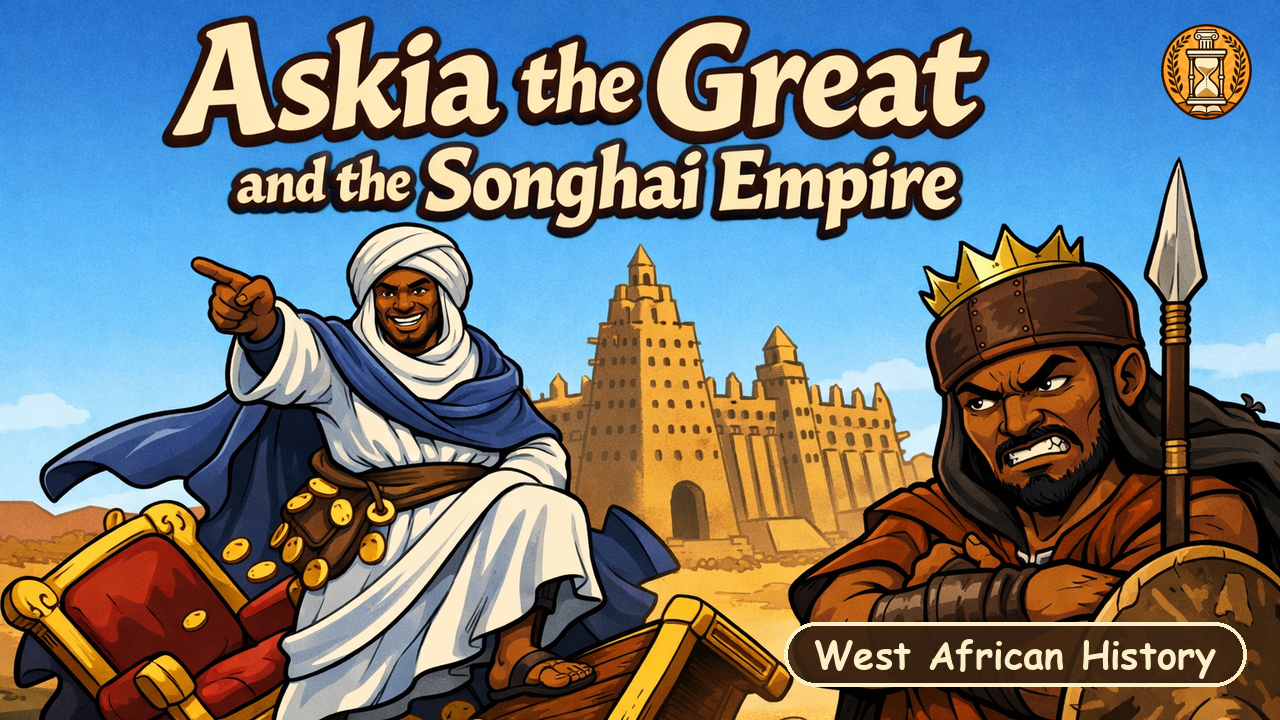
Sure, he was no Sonni, but even Sun Tzu would have to admit that Askia Muhammad had a pretty solid plan for world domination—or at least, domination of the Sahel. And he did it all without a single motivational poster.
The Original Corporate Restructuring
Let’s set the scene: It’s 1493, and the Songhai Empire is doing fine. Not great, but fine. The reigning boss, Sonni Baru, is the last of the Sonni dynasty, and he’s got the charisma of a damp towel. Enter Askia Muhammad, a general with the strategic brilliance of a chess grandmaster and the ambition of a middle manager who just discovered LinkedIn. He didn’t just overthrow Sonni Baru; he rebranded. No more Sonni dynasty—this was the Askia dynasty now, and the new CEO had a five-year plan.
The first order of business? Centralized bureaucracy. Because nothing says “golden age” like a well-organized tax system and a postal service that actually delivers. Askia didn’t just conquer land; he conquered paperwork. He divided the empire into provinces, appointed trusted governors, and basically invented the HR department. It was the administrative equivalent of swapping a rickety wooden cart for a sleek, horse-drawn SUV.
The Ultimate Work Trip: Mecca, 1496
Now, any self-respecting emperor needs a good PR stunt. So, three years into his reign, Askia Muhammad decided to take the ultimate business trip: a pilgrimage to Mecca. But this wasn’t your average “grab a souvenir and post a selfie” pilgrimage. This was a power move. He rolled into Cairo with enough gold to make a pharaoh blush and demanded an audience with the Abbasid caliph, Al-Mutawakkil III.
The caliph, clearly impressed by the sheer audacity and the mountain of bling, did something unprecedented: he appointed Askia as his official deputy for the Songhai Empire. That’s like getting a personal endorsement from the Pope and a lifetime supply of free pasta. But Askia didn’t just come back with a fancy title. He returned with a cargo hold full of scholars and architects, ready to turn Timbuktu into the intellectual powerhouse of the age. It was the ultimate “I went abroad and brought back culture” flex.
Timbuktu: The Original Ivy League
Under Askia’s watchful eye, Timbuktu became less of a dusty trading post and more of a desert Oxford. He funded mosques, universities, and libraries. Scholars flocked from across the Islamic world, and the city’s manuscripts became more valuable than gold. He didn’t just support scholarship; he aggressively sponsored it. If you were a mathematician, astronomer, or theologian, Askia was your patron, your landlord, and your biggest fan. It was a golden age, and the ink was flowing faster than the Niger River.
The Afterparty (And the Hangover)
But as with all great empires, the hangover was brutal. After Askia’s reign, his successors—sons like Askia Musa and Askia Daoud—tried to keep the party going. They built more, conquered a bit more, and generally kept things stable. But the dynasty had lost its edge. The bureaucracy that was once a strength became a bloated mess, and the succession disputes were messier than a toddler’s birthday cake.
Then came the final boss: Moroccan sultan Ahmad al-Mansur. In 1591, he sent an army across the Sahara—armed with gunpowder, which the Songhai famously lacked. It was the ultimate “my tech tree is better than yours” moment. The Songhai Empire, once the undisputed ruler of the Sahel, crumbled. Timbuktu’s libraries were looted, the scholars scattered, and the golden age turned to rust.
So, what’s the lesson? You can have the best administrative system, the most impressive pilgrimage, and the smartest people in the world. But if you can’t handle a few guys with muskets, you’re just a very well-organized footnote in history.
Askia the Great conquered the Sahel, but his empire’s greatest victory was briefly convincing everyone that bureaucracy was cool. Now that’s a legacy.
Chapters
- 0:00 — Introduction
- 0:15 — The Setting
- 0:23 — Askia overthrows Sonni
- 0:53 — Pilgrimage to Mecca
- 1:44 — Meeting with al-Maghili
- 2:41 — Return and reforms
- 3:29 — Conquest of Mossi
- 3:53 — The Ground
- 3:57 — Annexation of Agadez
- 4:46 — Campaign against Hausa
- 5:29 — Timbuktu’s golden age
- 6:20 — Askia’s tomb built
- 7:01 — Blindness and abdication
- 7:44 — Succession struggles
- 8:30 — Moroccan ambitions
- 9:19 — Invasion force assembled
- 9:55 — March across Sahara
- 10:45 — Battle of Tondibi
- 11:34 — Fall of Gao
- 12:18 — Occupation of Timbuktu