So, how did a city that couldn’t even sail straight take over the entire Mediterranean? The answer involves a lot of stabbing, a floating bridge, and an elephant that clearly didn’t read the itinerary.
The Mamertines: The Worst Houseguests in History
Picture this: It’s 264 BCE, and a bunch of rowdy Italian mercenaries decide to crash in the Sicilian city of Messana. They murder the husbands, marry the wives, and settle in for a good time. When a local Carthaginian garrison tries to evict them, the mercenaries—known as the Mamertines—do something desperate: they call Rome for help.
Rome, which had never really fought outside Italy, smelled an opportunity. Carthage already owned half of Sicily, and Rome didn’t like competition. So the Romans sailed over, kicked out the Carthaginians, and accidentally started the First Punic War. It would last 23 years, cost hundreds of thousands of lives, and teach Rome that water is very wet—and dangerous.
Rome Builds a Fleet (and a Really Weird Ramp)
Here’s the problem: Carthage owned the sea. Rome owned a few rowboats and a lot of confidence. The Romans needed a navy, so they did what any sensible empire would do: they copied a Carthaginian ship that washed ashore, built 100 replicas, and taught their soldiers to row on dry land.
But rowing doesn’t win naval battles—boarding does. Enter the corvus, a 1.2-ton bridge with a spike on the bottom. The Romans would sail up to a Carthaginian ship, drop the corvus, and turn a sea battle into a land battle on the water. At the Battle of Mylae in 260 BCE, consul Gaius Duilius used it to crush the Carthaginian fleet. The Romans cheered. The Carthaginians cursed.
But the corvus was a double-edged sword. It made Roman ships top-heavy and unstable. A few storms later, the Romans lost entire fleets to the weather. One general, Regulus, invaded Africa, got captured, and was sent back to Rome to negotiate peace—only to urge the Senate to keep fighting. Carthage responded by torturing him to death. Diplomacy, Punic style.
Hannibal: The Man, The Myth, The Alpine Traffic Jam
After Rome won the First Punic War (thanks to the Battle of the Aegates Islands in 241 BCE), Carthage was bankrupt and humiliated. But one general had a grudge. Hamilcar Barca made his nine-year-old son, Hannibal, swear an oath of eternal hatred for Rome. Hannibal would keep that promise like a kid keeps a grudge over stolen dessert.
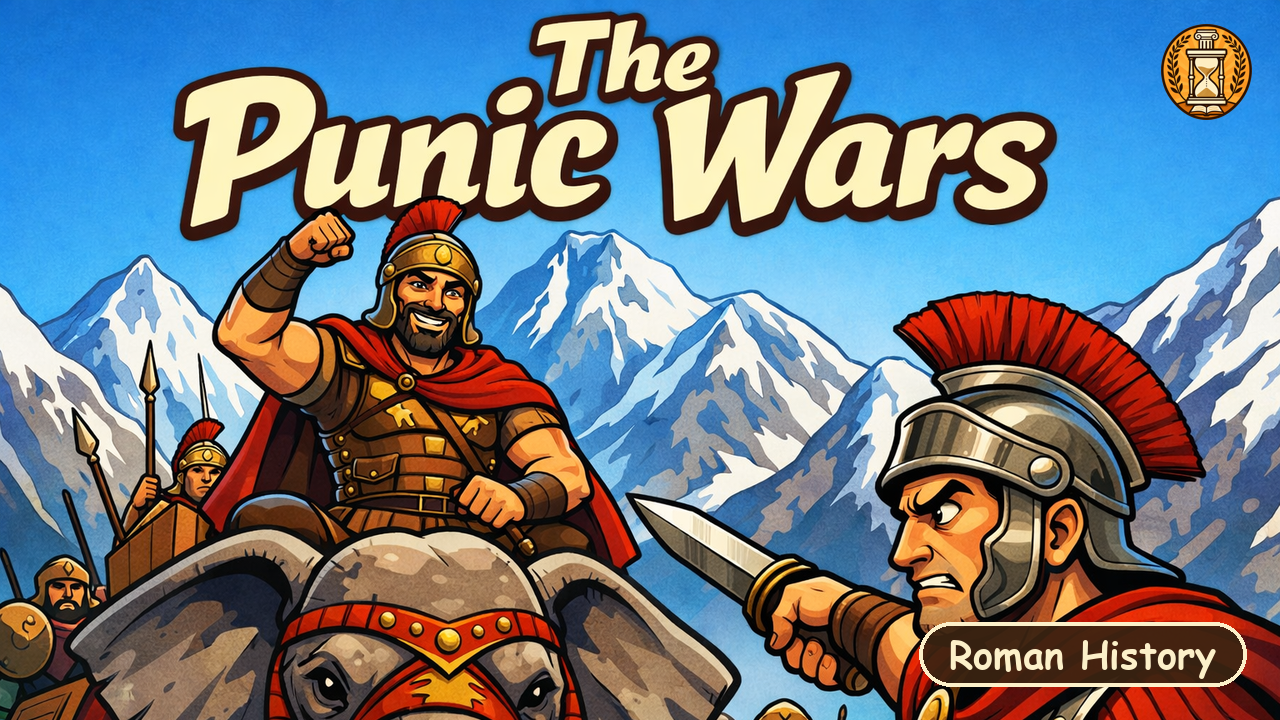
In 218 BCE, Hannibal did the unthinkable: he marched an army—including 37 war elephants—over the Alps. It was a logistical nightmare. Snow, avalanches, hostile tribes, and elephants that panicked on icy slopes. He lost half his army. But he did it. Rome panicked.
Hannibal then smashed Roman armies at Trebia, Lake Trasimene, and the infamous Battle of Cannae, where he encircled and annihilated 70,000 Roman soldiers in a single day. Rome’s response? They appointed Fabius Maximus, a man whose only strategy was “don’t fight Hannibal.” The Romans hated him for it—until they realized he was right.
Scipio’s Revenge and the Final Stab
While Hannibal roamed Italy, Rome bled. But they had a secret weapon: a young general named Scipio Africanus. Scipio realized you don’t beat Hannibal by fighting him—you beat him by making him go home. So he invaded North Africa.
Carthage panicked and recalled Hannibal from Italy. At the Battle of Zama in 202 BCE, Scipio faced Hannibal’s veterans—but this time, Rome had cavalry. With the help of the Numidian king Masinissa (who switched sides from Carthage), Scipio’s cavalry routed Hannibal’s flanks and then hit his rear. Hannibal lost. Carthage sued for peace.
The price? Carthage lost its empire, its navy, and its pride. Rome took Spain, Sicily, and North Africa. A few decades later, Rome would finish the job—literally salting the earth of Carthage. But that’s a story for another war, another tragedy, and another punchline.
So next time you complain about traffic or a family road trip, remember: Hannibal crossed the Alps with elephants, lost half his men, and still came closer to winning than anyone ever did. The Romans? They just built a better bridge.
Chapters
- 0:00 — Introduction
- 0:12 — The Setting
- 0:21 — Siege of Saguntum
- 0:58 — On the Move
- 1:02 — Hannibal Crosses the Alps
- 1:34 — Battle of Ticinus
- 2:06 — Battle of Trebia
- 2:42 — Battle of Lake Trasimene
- 3:15 — Fabius’ Delaying Strategy
- 3:43 — Battle of Cannae
- 4:07 — Capua Defects to Hannibal
- 4:37 — Siege of Syracuse
- 5:05 — Battle of the Metaurus
- 6:07 — Scipio Captures New Carthage
- 6:39 — Battle of Baecula
- 7:19 — Battle of Ilipa
- 8:03 — Scipio Invades Africa
- 8:33 — Battles of Utica and the Great Plains
- 9:05 — Hannibal Recalled to Africa
- 9:36 — Battle of Zama