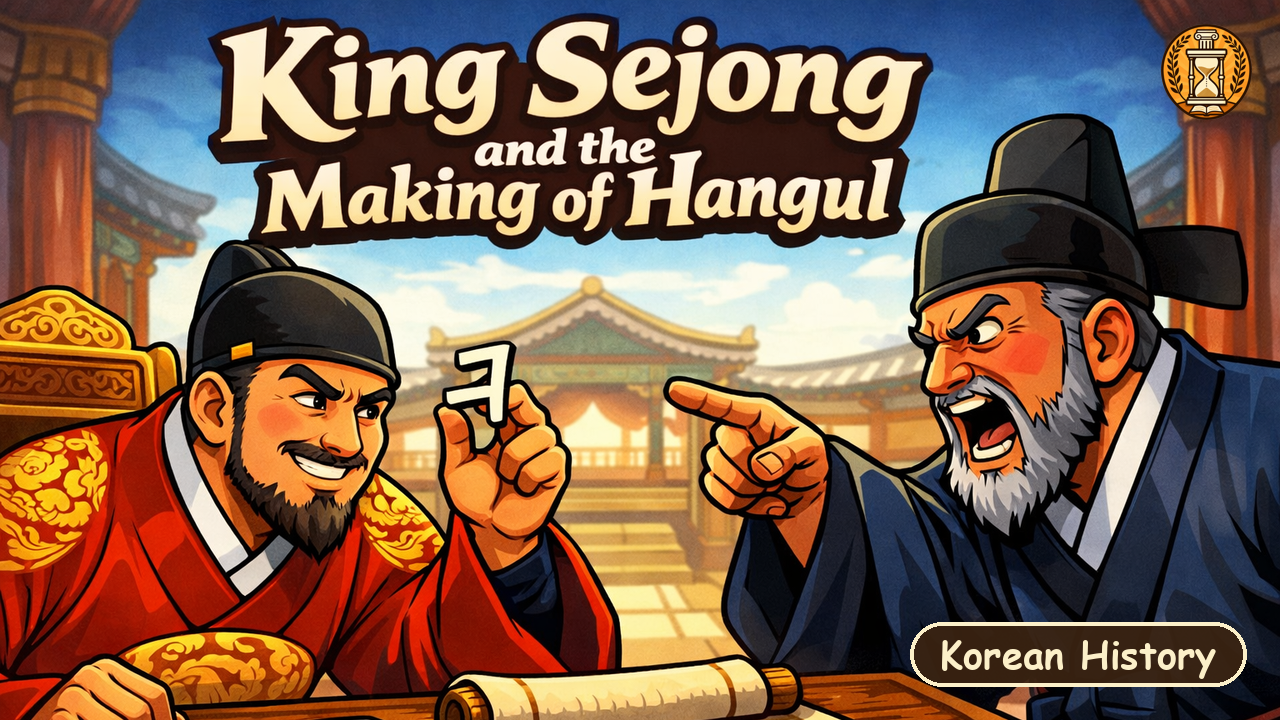
Imagine if your boss invented a new alphabet, taught it to you personally, and then had to fight the HR department to let you use it. That’s basically the story of Hangul, and it starts with a king who was way too smart for his own court.
The Problem: Chinese Characters Are a Terrible Fit (and a Terrible Gatekeeper)
In the 1440s, Korea had a literacy problem the size of the Great Wall. The official writing system was Classical Chinese—a language as unrelated to spoken Korean as Latin is to modern English. To read a government document, you needed years of grueling study. That meant only the aristocratic elite (the yangban) could read, write, and run the country. Everyone else? They were locked out of knowledge, law, and even their own names.
King Sejong the Great looked at this system and thought, “This is absurd.” He wasn’t just a monarch; he was a polymath who genuinely cared about his people. He wanted farmers, fisherwomen, and merchants to read. But you can’t just write Korean with Chinese characters—the grammar, sounds, and structure are completely different. It’s like trying to write a text message using only chess pieces. So, in a move that would terrify any modern project manager, he ordered his top scholars at the Jiphyeonjeon (the Hall of Worthies, basically a royal think-tank) to invent a whole new script from scratch.
The Genius Move: Letters That Look Like Your Mouth
Here’s where Sejong gets truly wild. He didn’t just ask for symbols; he asked for science. He and his scholars—including brilliant minds like Jeong Inji, Shin Suk-ju, and Seong Sam-mun—sat around analyzing speech sounds. They studied how the tongue, lips, and throat physically produce different sounds. Then, they designed letters based on articulatory phonetics. The letter for a velar sound (like “k”) is shaped like the back of the tongue blocking the throat. The letter for a dental sound (like “n”) is shaped like the tongue touching the teeth. The letter for “m” looks like a mouth. It’s the only writing system in the world where the alphabet is essentially a diagram of your face mid-sentence.
Sejong personally got his hands dirty in the design. This wasn’t a king delegating from a throne; this was a king in the lab with his sleeves rolled up. The result was Hunminjeongeum (“The Proper Sounds for Instructing the People”), published in 1446. It had 28 letters (now 24), was so logical you could learn it in a morning, and could represent every Korean sound perfectly. It was, and remains, a linguistic masterpiece.
The Backlash: “How Dare You Teach the Peasants to Read?”
You’d think people would throw a parade. Instead, the Confucian scholars threw a fit. Led by a guy named Choe Man-ri, they submitted a furious petition to the king. Their argument? “If the commoners can read, they’ll get ideas. Also, Chinese characters are the only ‘real’ civilization. This new alphabet is barbaric and will destroy our culture.”
Reading between the lines, they were terrified of losing their monopoly on knowledge. It’s like if the only person who knew the WiFi password was a feudal lord, and the king just posted it on the castle gate. Sejong, ever the pragmatist, ignored them. Hangul was used for poetry, law codes, and even instructional manuals for women and the illiterate. But after Sejong died, the elites went back to their Chinese snobbery. Hangul was pushed aside, called eonmun (“vulgar script”), and barely survived for 400 years. It was used in secret, mostly by women and the lower classes—the exact people it was designed for.
The Comeback: From “Vulgar Script” to National Treasure
Hangul’s renaissance didn’t come from a king; it came from a linguist and a bunch of nationalists. In the late 19th and early 20th centuries, as Korea faced foreign domination, Ju Si-gyeong—a brilliant linguist—revived Hangul as a symbol of Korean identity. He modernized it, gave it its name, and argued that a nation’s soul is in its own letters. Later, the Korean Language Society and nationalist activists (some of whom were jailed and tortured by the Japanese colonial government) kept the script alive as an act of resistance.
When Korea was liberated, Hangul became the official script. Today, it’s the proud, scientific, easy-to-learn alphabet that graces every Korean sign, book, and K-pop lyric. It’s a story of a king who trusted his people, a script that refused to die, and a punchline that the snobs lost in the end.
And the final word goes to Sejong: he gave you an alphabet you can learn before your coffee gets cold. Try doing that with Latin.
Chapters
- 0:00 — Introduction
- 0:37 — Commissioning the Hall of Worthies
- 1:12 — Research and Development
- 1:44 — Creation of Hangul
- 2:22 — Testing the Script
- 2:46 — On the Move
- 2:50 — Opposition from Scholars
- 3:23 — Sejong’s Defense
- 3:50 — Publication of Hunminjeongeum
- 4:11 — The Ground
- 4:15 — Publication of Hunminjeongeum
- 4:25 — Haerye Compilation
- 4:57 — Promotion of Hangul
- 5:34 — Sejong’s Death
- 6:21 — Mun Jong’s Support
- 6:50 — Sejo’s Usurpation
- 7:19 — Suppression of Hangul
- 7:48 — Elite Rejection
- 8:28 — Survival in Buddhism
- 9:05 — Hangul in the 19th Century