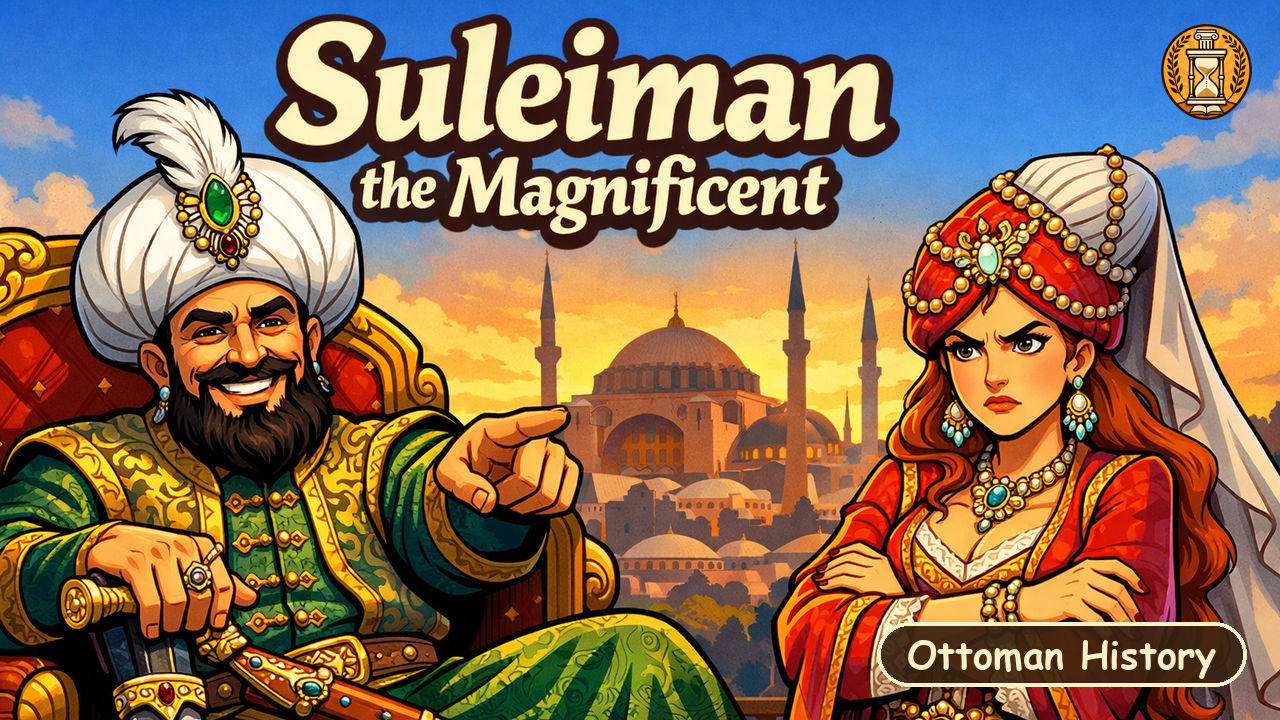
Suleiman the Magnificent was the 16th-century sultan who made the Ottoman Empire so terrifying that European kings had to invent a new emotion: “polite diplomatic fear.”
The Guy Who Had Everything, Including a Body Count
Suleiman took the throne in 1520 after his father, Selim I, conveniently died—a career path that, in the Ottoman family, was less “succession” and more “final round of a battle royale.” Over the next 45 years, Suleiman would terrorize Europe, codify law, and build things so pretty that architects still cry about them today. Europeans called him “Magnificent” because he was, at all times, one bad negotiation away from showing up at your capital with 100,000 troops and a grudge. His own people called him Kanuni—”The Lawgiver”—because he also had a surprisingly nerdy side.
The Hobby That Was Basically “Conquering Stuff”
Suleiman’s military CV reads like a franchise reboot that just kept getting sequels. First, he marched on Belgrade (1521) and took it, because Hungary’s King Louis II was busy being young and doomed. Then Rhodes (1522), where he kicked out the Knights Hospitaller, who had been squatting there like the world’s most heavily armed Airbnb guests. His navy, led by the magnificently named Hayreddin Barbarossa, turned the Mediterranean into an Ottoman lake, prompting Holy Roman Emperor Charles V to write increasingly desperate letters to everyone who would listen.
The crowning moment came at the Battle of Mohács in 1526, where Suleiman obliterated Louis II’s army. Louis died in the retreat—drowned in a creek while wearing too much armor, which is the 16th-century equivalent of tripping into a puddle on the way to your own funeral. Suleiman, ever the magnanimous winner, reportedly felt bad about it. Not “return the kingdom” bad, but still.
The Lawgiver Who Actually Gave a Hoot
While his cannons were making Europe nervous, Suleiman was also quietly revolutionizing Ottoman governance. He commissioned the Kanun—a codified legal system that smoothed over the clash between sharia law and secular edicts. Think of it as the Ottoman equivalent of a terms-of-service update, but one that actually protected peasants from being arbitrarily squeezed by nobles. His chief legal brain, Ebussuud Efendi, was the kind of jurist who made administrative reform feel like a blockbuster. Suleiman even passed laws about what people could wear, because if you’re going to run an empire, someone has to decide who gets to sport the fancy turban.
This is also where his nickname splits in two: Europeans saw a conqueror, Ottomans saw a bureaucrat. Both were right. He was the rare ruler who could declare war on the Habsburgs and fix your property dispute.
The Power Couple That Broke the Harem Script
Here’s where it gets spicy. Suleiman broke centuries of tradition by actually marrying a woman from his harem: Hürrem Sultan. She wasn’t just a wife; she was a political operator who corresponded with foreign kings, influenced appointments, and made his previous favorite, Mahidevran Sultan, very, very annoyed. Hürrem’s rise was the 16th-century equivalent of a reality TV contestant winning the whole show and then buying the network.
Her son-in-law, Rüstem Pasha, became grand vizier through sheer marital proximity and a talent for financial corruption. And then there’s the tragedy: Suleiman had his own son, Mustafa, executed in 1553 on suspicion of rebellion. Mustafa was the son of Mahidevran, and his popularity was too dangerous. Suleiman ordered the kill, wept about it, and history still argues whether Hürrem and Rüstem whispered the accusation. Either way, the succession ended up with Selim II—known as “Selim the Blond” or, less charitably, “Selim the Drunk.” The golden age was starting to develop a wine stain.
The Legacy Is Literally Everywhere
Suleiman’s reign also gave us Mimar Sinan, the greatest architect in Ottoman history. Sinan built the Süleymaniye Mosque in Istanbul, a masterpiece that still makes modern skyscrapers look like they tried too hard. The sultan patronized art, poetry, and urban planning, all while managing a multi-continental empire with the calm of a man who knows he has the best army.
He died in 1566 during a campaign in Hungary, at age 71, still technically on the job. By then, Europe had learned to dread him, his subjects had learned to respect him, and his family had learned to hide the sharp objects.
Suleiman was the complete package: conqueror, lawgiver, builder, and family drama protagonist. He made the Ottoman Empire the envy of the world, then left his successors a perfectly tuned machine and a messy succession. The golden age didn’t end with his death—it just started drinking.
Chapters
- 0:00 — Introduction
- 0:26 — The Ground
- 0:30 — Suleiman ascends throne
- 0:48 — Capture of Belgrade
- 1:35 — Siege of Rhodes
- 2:23 — Battle of Mohács
- 3:07 — Sack of Buda
- 3:16 — On the Move
- 3:20 — Sack of Buda
- 3:48 — First Siege of Vienna
- 4:43 — Siege of Kőszeg
- 5:23 — Ibrahim Pasha executed
- 6:20 — Campaign against Safavids
- 7:02 — Battle of Preveza
- 7:50 — Hürrem’s influence grows
- 8:41 — Execution of Mustafa
- 9:32 — Siege of Szigetvár
- 10:48 — Suleiman’s legacy