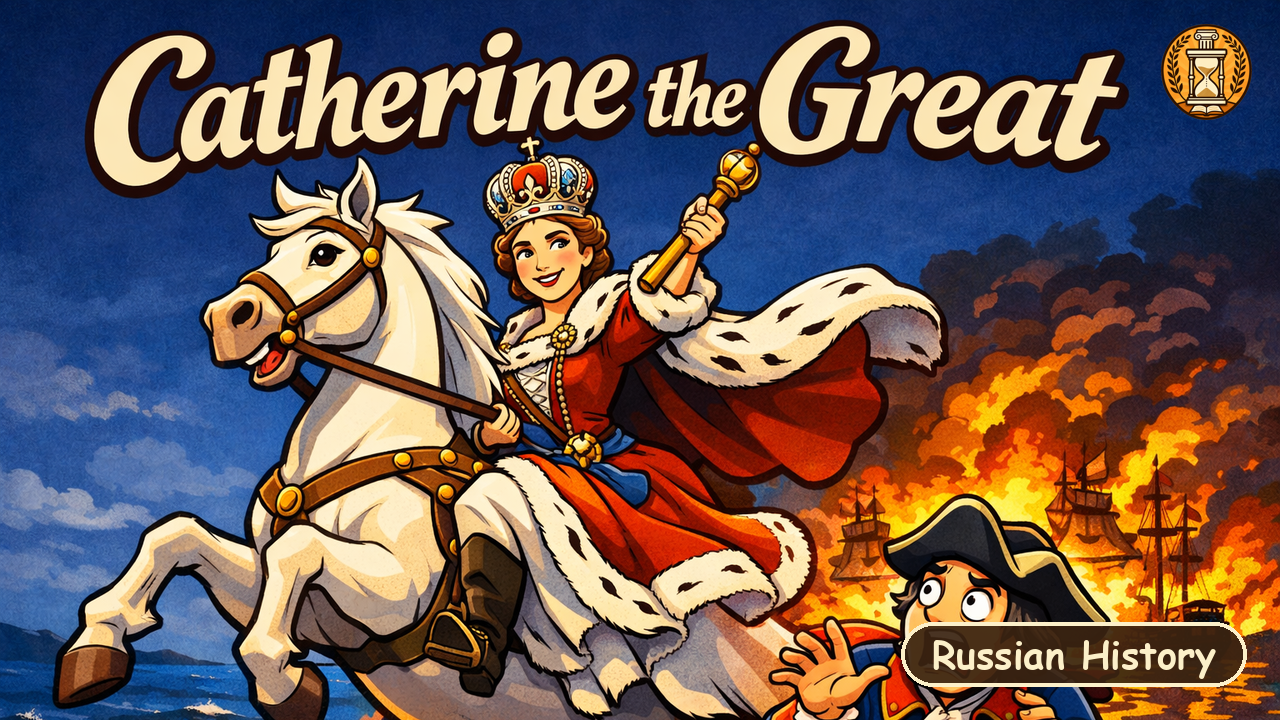
You know how they say “marry your job”? Catherine the Great basically married the Russian Empire, and her husband was just the awkward guy in the way.
Catherine wasn’t even Russian. She was a minor German princess named Sophie, shipped off to St. Petersburg as a teenager to marry the heir to the throne, Peter III. One look at Peter—who was more interested in toy soldiers and his Prussian heroes than in his wife—and you can guess the marriage was a disaster. Peter openly talked about divorcing her, which in royal circles is less “we need space” and more “I’m about to make you a very inconvenient ghost.” So Catherine did what any sensible person would: she started plotting.
The Coup That Was More Soap Opera Than Revolution
By 1762, Peter III had managed to alienate just about everyone. He made peace with Prussia—because he idolized Frederick the Great—and he threatened to divorce Catherine and marry his mistress. Meanwhile, Catherine was busy being charming, reading Enlightenment philosophy, and building a friendship with Grigory Orlov, a handsome cavalry officer, and his brother Alexei. Throw in Nikita Panin, a seasoned diplomat, and the fiery young Princess Ekaterina Dashkova, and you had a plot brewing faster than bad court gossip.
On July 9, 1762, Catherine rode to the guards regiment in St. Petersburg, was proclaimed empress, and Peter III signed an abdication faster than you can say “I never wanted the throne anyway.” Days later, he died under mysterious circumstances—officially from “hemorrhoidal colic,” which remains the most creative euphemism for “we took care of it” in history. Catherine, tearful and innocent, took the crown. We all believe you, Catherine.
Enlightenment Vibes, But Make It Authoritarian
Catherine loved ideas. She corresponded with Voltaire and Denis Diderot, bought their libraries, and called herself an “Enlightenment philosopher on the throne.” She reformed Russian law, encouraged education, and loved a good philosophical chat more than most people love a good nap.
But here’s the twist: she needed the nobles to keep their power, which meant keeping the serfs very much in serfdom. Enlightenment for everyone, unless you were a peasant, in which case, back to the fields. When a Cossack named Yemelyan Pugachev—a clever, charismatic ex-military man—declared himself the “real” Peter III (yes, the dead guy, but who’s counting?) and rallied peasants and Cossacks against the nobles, Catherine didn’t hesitate. He captured Kazan and threatened Moscow, so she sent General Alexander Suvorov, her finest military bulldog. Suvorov crushed the rebellion, and Pugachev was executed. The lesson? Catherine loved ideas, but she loved her throne more.
Expansion, Conquest, and the World’s Most Ambitious Boyfriend
If Catherine had a hobby, it was conquering things. She annexed the Crimea from the Ottoman Empire, impressing Sultan Abdul Hamid I so much that he immediately lost a war. Then she carved up Poland with Frederick the Great and Austria, installing her former lover Stanisław August Poniatowski as King of Poland—basically the 18th-century version of “you can be our guy, but we’re still taking the lawn.”
Her greatest partner in crime was Grigory Potemkin, a flamboyant military genius and her longtime lover. Potemkin was so devoted he supposedly built fake villages to impress her—the “Potemkin villages” of legend—though historians doubt it. Still, he did help her secure the Crimea and project an image of the “beautiful tsar.” Catherine, in a world ruled by men, knew she had to be twice as brilliant, twice as ruthless, and three times as good at PR. She styled herself as a serene, powerful, all-knowing mother of the nation, even as she schemed, murdered, and partitioned her way across Eastern Europe.
Her son Paul I hated her, which is fine, because she spent her reign trying to make sure he wouldn’t inherit a mess. She died in 1796, leaving behind an empire that stretched from the Baltic to the Black Sea, a reputation as the greatest ruler Russia ever had, and a legacy so strong that even the horses didn’t complain.
Catherine the Great: she came to Russia as a nobody, seized a throne, modernized a country, crushed a rebellion, and conquered half a continent—all while wearing a gown and a smile.
Now that’s a power move.
Chapters
- 0:00 — Introduction
- 0:12 — The Setting
- 0:22 — Catherine’s Arrival in Russia
- 1:18 — Marriage to Peter
- 1:47 — On the Move
- 1:51 — Marriage to Peter
- 2:19 — Coup Against Peter III
- 3:16 — Coronation of Catherine
- 4:08 — Assembling the Legislative Commission
- 4:34 — The Ground
- 4:38 — Assembling the Legislative Commission
- 5:08 — First Partition of Poland
- 5:47 — Russo-Turkish War Begins
- 6:42 — Battle of Chesma
- 7:36 — Rumyantsev’s Victories
- 8:15 — Treaty of Küçük Kaynarca
- 8:54 — Annexation of Crimea
- 9:35 — Potemkin’s Rise
- 10:19 — Journey to the Crimea
- 11:03 — Second Russo-Turkish War