You know how your last Amazon order took a wrong turn through six different states before arriving two weeks late? Well, in the 1340s, the wrong turn was a flea, the package was the bubonic plague, and the delivery address was “literally everyone in Europe.” Here’s the story of the worst package delivery in human history.
The Silk Road: The Original Prime Delivery Service
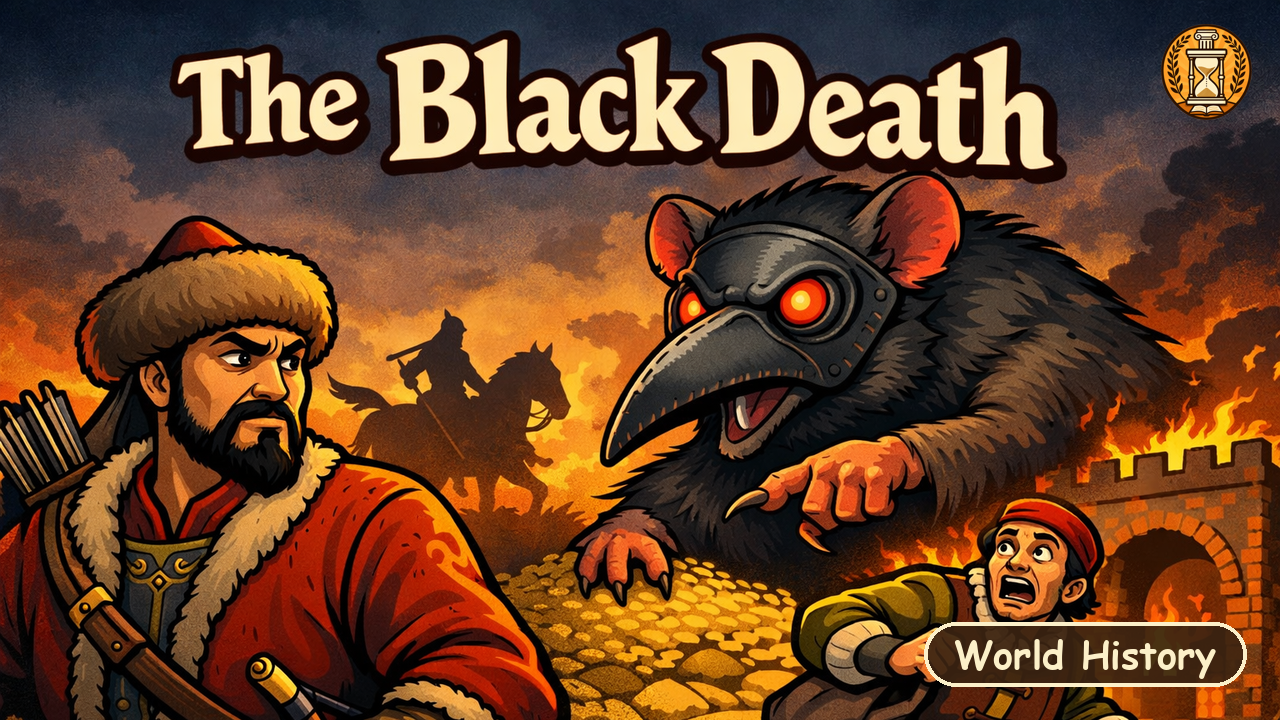
Our story begins not in a bustling European port, but in the quiet, unassuming rodent populations of Central Asia. There, a bacterium called Yersinia pestis was living its best life, happily bouncing between rats and fleas with zero ambition. But in the 1330s, the Mongolian Empire’s Silk Road—the medieval equivalent of an interstate highway system with worse rest stops—became the plague’s personal Uber. Caravans of merchants, soldiers, and their uninvited flea-ridden rat entourage carried the disease westward. It was a logistical triumph for the bacteria, an absolute disaster for everyone else.
By 1344, the plague had hit the Mongol army besieging the Genoese trading post of Caffa in Crimea. Here’s where it gets spicy. The Mongol khan, Janibeg, famously had his soldiers catapult infected corpses over the city walls. Genoese chroniclers like Gabriele de’ Mussi and Michele da Piazza were positive this was biological warfare. Modern historians like Monica Green point out that the rats were probably sneaking in anyway, but let’s be honest: if your enemy is lobbing dead bodies at you, you’re not going to stop and fact-check the transmission vectors.
The Genoese Cruise Ship from Hell
The Genoese merchants, being pragmatic survivors, did what any sensible person would do: they got on ships and sailed away. Unfortunately, they brought their new friends—the fleas, the rats, and the plague—with them. When they docked in Messina, Sicily, in October 1347, the locals were not thrilled. As historian Ole Benedictow dryly notes, the disease didn’t just walk off the gangplank; it sprinted.
From Messina, the plague exploded. Italy, Southern France, then Paris and London by 1348. It moved like a viral TikTok trend, but instead of dance moves, it spread boils and a 60% mortality rate. Here’s a fun fact: the first quarantine measures were introduced in Venice and Ragusa (modern-day Dubrovnik), requiring ships to anchor for 40 days—the quaranta giorni. It was a brilliant idea, except the fleas were perfectly happy to wait 40 days and then bite you anyway. So, good effort, Venice. A for creativity, F for effectiveness.
Flagellants, Popes, and a Whole Lot of “The End is Nigh”
Socially, Europe went completely bananas. With Pope Clement VI sitting in Avignon (he wisely quarantined himself between two huge fires, which actually worked—heat repelled fleas), the masses turned to the most dramatic option available: the Flagellants. These guys marched through towns, whipping themselves bloody in public, convinced that God was punishing humanity for… well, for being human, probably. It was the medieval equivalent of rage-quitting a video game and blaming the controller.
Meanwhile, King Edward III of England had a different problem. With up to half his workforce dead, labor was suddenly scarce, and peasants realized they had leverage. Cue the Ordinance and Statute of Labourers, which tried to freeze wages at pre-plague levels. This went over about as well as you’d expect. When King Richard II tried to enforce a poll tax in 1381, the peasants, led by Wat Tyler and the radical priest John Ball, marched on London. Ball’s sermon was essentially the medieval “Eat the Rich”: “When Adam delved and Eve span, who was then the gentleman?” They got killed, obviously, but the damage was done. Charles the Bad of Navarre even got in on the chaos, but honestly, with a name like that, he was always going to be a background character.
The Feudal System Gets a Pink Slip
The chronicler Henry Knighton noted that livestock roamed wild because there was no one to tend them, and a sheaf of corn was worth three times its pre-plague price. The old feudal order—serfs tied to the land, lords demanding free labor—was basically dead on its feet. The survivors demanded better pay, better conditions, and to not be treated like disposable furniture. Giovanni Boccaccio, writing the Decameron, framed his tales as a group of nobles fleeing the plague in Florence, a chilling reminder that even the wealthy had to run. Giovanni de’ Bardi, a banker, probably watched his entire loan portfolio evaporate, because nothing ruins a credit market like your borrowers being dead.
The Black Death didn’t just kill people; it killed the system. The lords were desperate for labor, the peasants knew it, and the resulting revolts and wage hikes cracked the foundation of feudalism so hard it never recovered. The Middle Ages were over, not with a bang, but with the sound of a scythe and a very angry peasant demanding a living wage.
So, next time you complain about a delayed shipment, remember: at least your package isn’t dead. And if it is, please don’t catapult it over the neighbor’s fence.
Chapters
- 0:00 — Introduction
- 0:28 — Silk Road spread
- 0:55 — The Ground
- 0:59 — Siege of Caffa begins
- 1:34 — Biological warfare
- 2:03 — Genoese flee Caffa
- 2:28 — Plague reaches Constantinople
- 3:05 — Arrival in Messina
- 3:39 — Spread to mainland Italy
- 3:50 — On the Move
- 3:54 — Spread to mainland Italy
- 4:04 — Plague in Florence
- 4:41 — Flagellant movement
- 5:15 — Pogroms against Jews
- 5:48 — Plague reaches France
- 6:20 — Plague in England
- 6:52 — Death of Alfonso XI
- 7:21 — Social and economic upheaval
- 8:29 — Decline of feudalism
- 8:57 — Medical responses