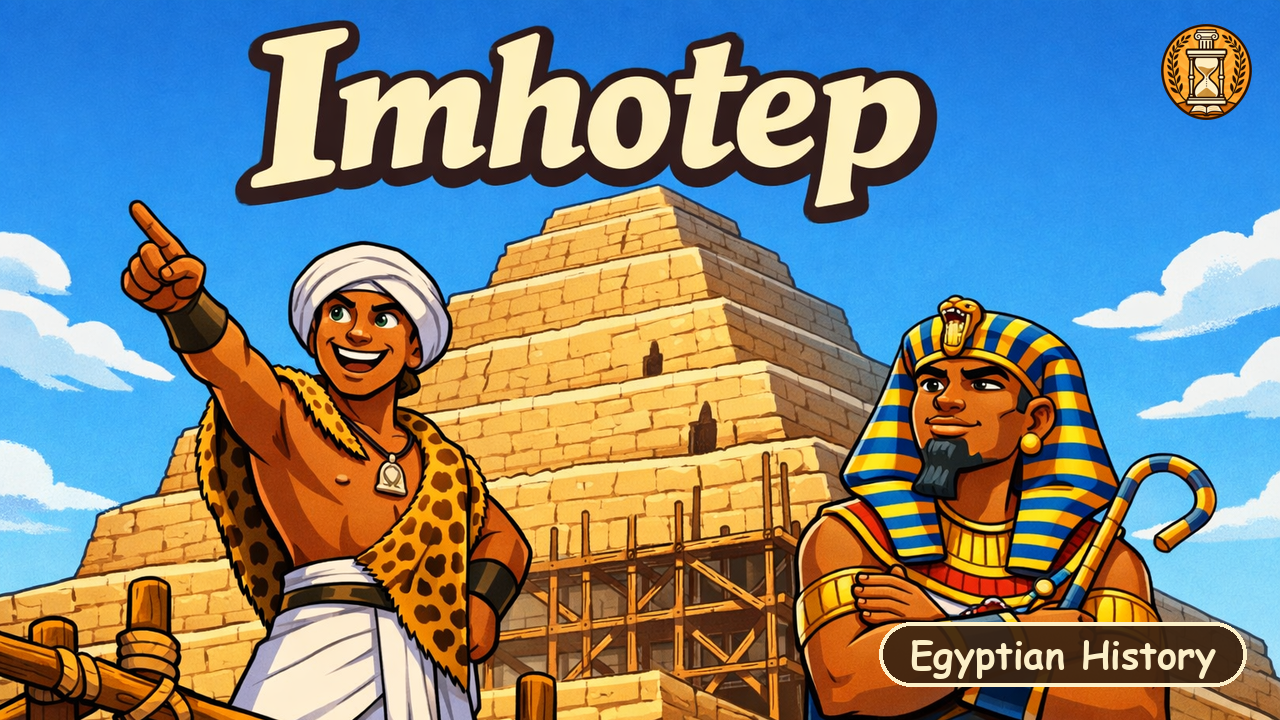
Picture a man so brilliant that 2,000 years after his death, people were still leaving him “Get Well Soon” cards—except the cards were carved in stone and the sick were convinced he’d actually cure them. That’s Imhotep: the only mortal in history to pull off the ultimate career pivot—from architect to physician to full-blown deity. Not bad for a guy who started life as a commoner.
The Commoner Who Ran Ancient Egypt
Imhotep’s origin story is the ancient world’s version of a mailroom clerk becoming CEO—except the company was a theocracy and the CEO was a god-king. Born in Memphis (not the Tennessee one, sadly) as a commoner, Imhotep’s rise would make modern LinkedIn influencers weep with envy. He caught the eye of Pharaoh Djoser, who, in a move that would shock no one who’s seen political appointments, made him chief vizier—essentially Prime Minister, head judge, and the guy who signed off on everything.
But here’s the kicker: Djoser didn’t just want a bureaucrat. He wanted a legacy. And Imhotep was about to deliver the ancient equivalent of a skyscraper, a medical school, and a TED Talk on brain surgery—all rolled into one.
The Step Pyramid: A Ziggurat’s Revenge
Before Imhotep, Egyptian tombs were flat, rectangular benches called mastabas. Boring. Funeral-adjacent. Imhotep looked at that and thought, “What if we stacked six of them on top of each other and called it a day?” Thus, the Step Pyramid at Saqqara was born—the world’s first monumental stone building, and history’s first “hold my beer” moment in architecture.
As supervisor of construction, Imhotep didn’t just draft blueprints. He managed thousands of workers, many of whom got injured on the job. Treating crushed fingers and broken backs wasn’t in the vizier job description, but Imhotep rolled up his linen sleeves and got to work. This wasn’t just charity; it was the world’s first on-site occupational health clinic, staffed by a polymath who clearly never slept.
The Papyrus That Described Your Brain (2,000 Years Early)
Imhotep’s medical legacy survives in the Edwin Smith Papyrus—a surgical text so advanced it reads like a trauma manual from the future. While other ancient doctors blamed demons for headaches, Imhotep wrote about cases. He described the brain, the meninges, and cerebrospinal fluid—a full 2,000 years before anyone else thought to look inside the skull without a hammer and a prayer.
He classified injuries, noted that the brain controls the body, and suggested treatments that sound eerily like modern emergency care—minus the antiseptic and the paperwork. His cases range from “a wound on the skull” to “a dislocation of the jaw”—each with a prognosis: treatable, uncertain, or “don’t bother.” This wasn’t mysticism; it was the birth of clinical observation. If Imhotep had a white coat, he’d have been the first to accidentally write “see me in 3 weeks” on a papyrus.
From Mortal to God: The Anti-Asclepius
So how does a vizier become a god of medicine? Patience, PR, and a really long track record. After his death, Imhotep’s reputation as a healer grew. By the Late Period, Egyptians were praying to him for cures, building temples in his name, and offering him little clay limbs as thanks—the ancient equivalent of leaving a five-star review for your chiropractor.
Then came the Greeks. They saw Imhotep’s cult and did what the Greeks did best: assimilated it. They identified him with Asclepius, their own god of medicine, creating a divine mashup that would dominate healing for centuries. Temples called Asklepieia popped up across the Mediterranean, where patients slept in dormitories hoping for a dream-prescribed cure—basically a spa retreat with better insurance.
Imhotep’s influence didn’t just survive; it thrived. While other Egyptian gods faded into museum exhibits, Imhotep became a household name in Greek medicine—a commoner who out-godded the gods.
—
Imhotep built the first stone pyramid, described the brain before anyone knew what it was for, and then got promoted to deity—all without a medical degree, an engineering license, or a PR team. The next time you feel underappreciated for a well-arranged spreadsheet, remember: somewhere in ancient Memphis, a commoner is laughing at you from the pantheon.
Chapters
- 0:00 — Introduction
- 0:55 — Designing the Step Pyramid
- 1:34 — Construction of the pyramid complex
- 1:48 — The Ground
- 1:52 — Construction of the pyramid complex
- 2:35 — Medical practice and Edwin Smith Papyrus
- 3:34 — Famine relief during Djoser’s reign
- 4:22 — Death and burial at Saqqara
- 5:21 — Deification in the Late Period
- 6:02 — Temple of Imhotep at Saqqara
- 6:36 — Association with Aesculapius
- 7:17 — Medical texts influence on Hippocrates
- 7:48 — Imhotep in Ptolemaic literature
- 8:31 — Pilgrimage to Imhotep’s sanctuaries
- 9:34 — On the Move
- 9:38 — Pilgrimage to Imhotep’s sanctuaries
- 9:50 — Imhotep’s wisdom literature
- 10:37 — Comparison with Amenhotep son of Hapu
- 11:18 — Imhotep in Christian and Islamic tradition
- 12:01 — Rediscovery of Imhotep’s legacy