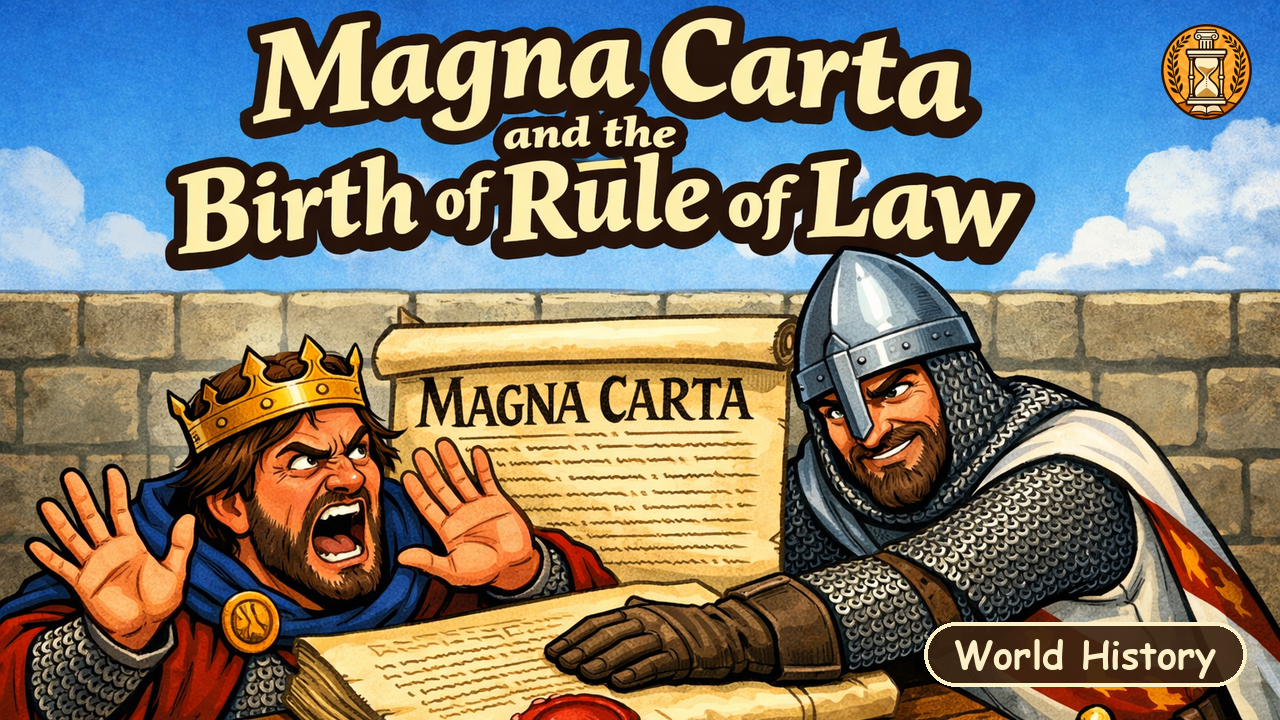
King John was the medieval equivalent of a guy who loses the family business, blames the employees, and then invoices them for the privilege.
The Worst Boss in England
In 1204, John lost Normandy to Philip II of France. Losing an entire duchy takes a certain kind of talent, but John had it. He then decided to win it back the only way he knew how: by billing everyone in England. He jacked up taxes and leaned hard on scutage — a fee nobles could pay instead of showing up for military service. Fine in principle. Except John charged it constantly, fought constantly, lost constantly, and pocketed the difference.
The barons noticed. Barons are basically professional noticers.
The Pope vs. the King (a Scheduling Conflict)
Then John picked a fight with Pope Innocent III over who got to be Archbishop of Canterbury. John wanted his guy; the Pope installed Stephen Langton. John responded by refusing the appointment, and Innocent responded by excommunicating him. In 1213, John — now excommunicated, broke, and facing a French invasion — did the medieval power move of surrendering England to the Pope and getting it back as a papal fief. He’d turned his own kingdom into a rental property. It worked. The Pope now had a vested interest in keeping John on the throne, which John assumed meant unlimited job security.
He assumed wrong.
Runnymede: The Sealing, the Annulment, and Everyone’s Least Favorite Clause 61
The barons, led by Robert Fitzwalter, had been organizing. In 1215 they marched on London, handed John the Articles of the Barons as a starting draft, and effectively said: sign here or we redecorate the palace with you in it. On June 15, 1215, at Runnymede, John sealed Magna Carta.
It was not a warm moment. It was a hostage negotiation with better calligraphy.
Two clauses mattered most. Clause 39: no free man shall be imprisoned or stripped of rights except by lawful judgment or the law of the land. Clause 40: to no one will we sell, deny, or delay right or justice. Congratulations, humanity — you’ve just been introduced to due process.
The celebration lasted roughly ten weeks. Innocent III annulled the Charter, calling it shameful and illegal, and John happily tore it up. The war restarted immediately. For a document that supposedly founded modern liberty, its launch was closer to a failed product recall.
The Charter’s Extremely Confusing Afterlife
Here’s the joke history loves: Magna Carta was a flop that became a legend. Sir Edward Coke, centuries later, dusted it off and argued it proved even kings answered to law — using it against the Stuarts. Oliver Cromwell’s crowd waved it around during the English Civil War. Then Thomas Jefferson and the American founders borrowed its logic for their own grievances against a different king who also had tax opinions.
A peace treaty between a bad king and grumpy barons, voided within months, became the citation for human rights.
The Point
Magna Carta didn’t create the rule of law. But it was the first time English barons wrote down, in ink, that the crown wasn’t above it — and once an idea like that gets loose, no pope, king, or paperwork can stuff it back in the box.
Chapters
- 0:00 — Introduction
- 0:34 — Battle of Bouvines
- 1:17 — Barons Demand Charter
- 1:38 — On the Move
- 1:42 — Barons Demand Charter
- 1:54 — Barons Renounce Fealty
- 2:19 — Rebels March on London
- 2:32 — The Ground
- 2:36 — Rebels March on London
- 3:19 — John Seeks Mediation
- 3:49 — Magna Carta Sealed
- 4:15 — Charter Distributed
- 4:57 — Pope Annuls Charter
- 5:39 — First Barons’ War
- 6:32 — Louis Invades England
- 7:00 — John’s Counterattack
- 7:34 — John Loses Baggage
- 8:09 — Death of King John
- 8:55 — Magna Carta Reissued
- 9:47 — Battle of Lincoln