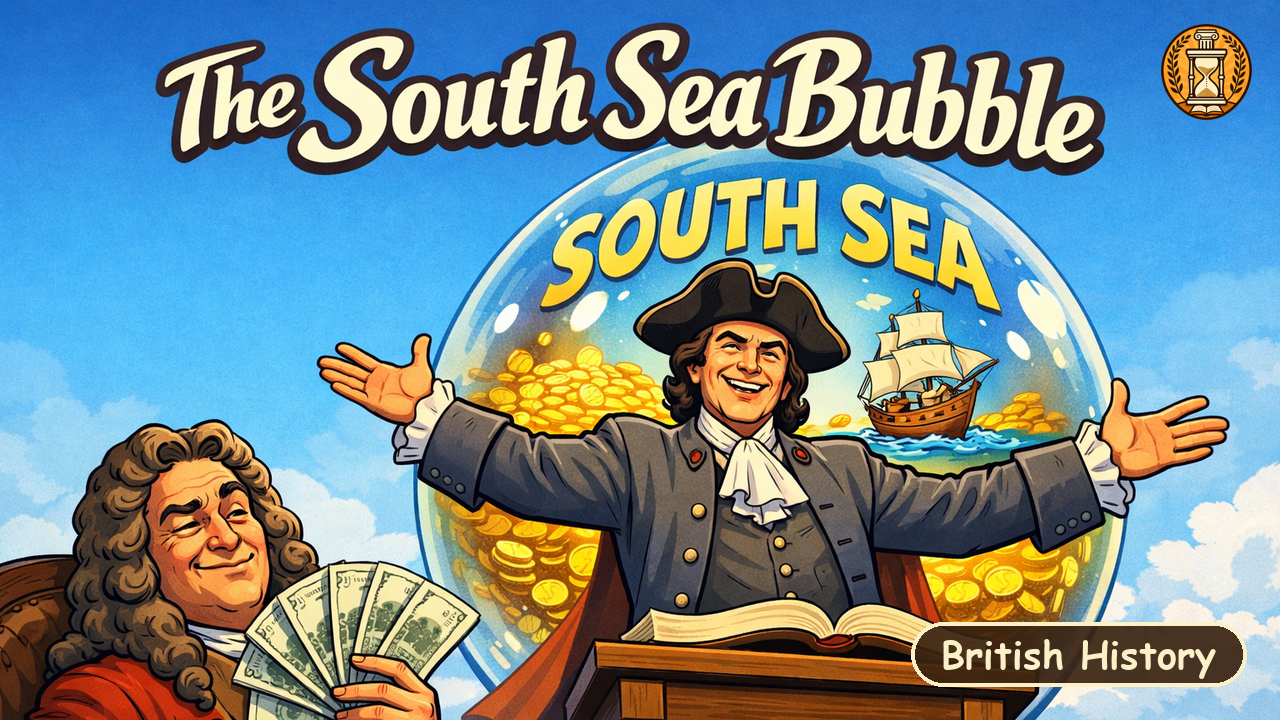
If you’ve ever lost money on a meme stock, a crypto rug pull, or that “can’t miss” Beanie Baby you bought in 1998, you have a 300-year-old ancestor in financial madness: the South Sea Bubble. By 1720, England had invented the art of getting stupidly rich on a lie, then spectacularly poor on the truth.
The Genius Plan: Sell a Monopoly That Doesn’t Exist
It started in 1711, when Robert Harley, the Chancellor of the Exchequer, had a brilliant idea. England was deep in war debt, so he chartered the South Sea Company and gave it an exclusive monopoly to trade with South America. One small problem: Spain controlled South America, and Spain and England were at war. The monopoly was, generously put, a fig leaf.
Then came the Peace of Utrecht in 1713. Spain grudgingly granted the Company a limited trade right—basically permission to sell a few shiploads of goods per year. The Company’s actual business? Essentially, zero. But that didn’t stop John Blunt, the company’s chief schemer, from acting like they’d discovered El Dorado.
The Debt-for-Stock Trick (or: How to Bribe a Government)
In 1719, Blunt proposed a dazzlingly shady plan: the South Sea Company would take over much of Britain’s national debt. In exchange, the government would let the Company convert government bonds into its own shares. Bondholders, you see, were getting a measly 5% interest. But the Company promised them glorious profits from South American trade—profits that would definitely, absolutely materialize any day now.
The plan was approved, largely because the Company had bribed half of Parliament. King George I became a governor of the Company (and got a fat bonus of shares). James Craggs the Younger, the Postmaster General, and Charles Stanhope, a senior minister, were on the take. James Craggs the Elder, his father, was stuffing his pockets too. It was less a financial scheme and more a protection racket with a royal warrant.
The Madness: From £120 to £1,000 in a Few Months
By early 1720, the speculation began. The share price, which had languished around £120, started creeping up. Then it galloped. By April, the first wave of euphoria pushed it to £300. People who had never traded a share in their life were suddenly “investors.” The Company printed more shares, sold them on credit, and even lent people money to buy more shares. It was a Ponzi scheme with powdered wigs.
In June 1720, the stock hit its peak: £1,000 per share. A single share could buy you a small mansion. The Company, meanwhile, was reporting fake profits and paying dividends in—wait for it—more shares. To crush competition, it bribed Parliament to pass the Bubble Act, which outlawed rival joint-stock companies. If you were going to lose your savings, by God, you’d lose them on their scam.
Among the true believers was Isaac Newton. Yes, the Isaac Newton. He bought in early, sold at a profit, then bought back in at the top. He lost £20,000 (millions today). He later muttered, “I can calculate the motion of heavenly bodies, but not the madness of people.” Even geniuses get burned.
Lady Mary Wortley Montagu, a sharp-tongued writer and early investor, was smarter. She saw the writing on the wall and sold before the crash. She turned a tidy profit, then spent the rest of her life writing witty letters about how everyone else was an idiot.
The Pop, the Panic, and the Cleanup
The bubble burst in late 1720. Investors realized the company had no actual profits, just promises and bribes. The stock cratered. Fortunes vanished. The Bank of England nearly collapsed. Parliament launched an investigation, and the Craggses and Stanhope were exposed as corrupt clowns. James Craggs the Younger died in disgrace. His father killed himself. Charles Stanhope survived but was ruined.
Enter Robert Walpole, the one politician not on the Company’s payroll. He cleaned up the mess, restored confidence, and became Britain’s first de facto Prime Minister. His motto? “Every man has his price.” He knew the system was rotten, so he made it work anyway.
The South Sea Bubble didn’t destroy British finance—it reshaped it. It taught the world that if you make a promise too good to be true, someone will believe it. And then, 300 years later, someone will sell it as an NFT.
So next time you see a stock triple in a week, remember Isaac Newton. Even geniuses get it wrong. Especially when they buy at the top.
Chapters
- 0:00 — Introduction
- 0:37 — Treaty of Utrecht 1713
- 1:08 — On the Move
- 1:11 — South Sea Bill proposed
- 1:43 — South Sea Bill passed
- 1:51 — The Ground
- 1:55 — South Sea Bill passed
- 2:10 — Share price rises
- 2:43 — First subscription
- 3:19 — Bribery of politicians
- 3:46 — Share price peaks
- 4:08 — Bubble Act passed
- 4:40 — Insider selling begins
- 5:06 — Share price starts to fall
- 5:27 — Bank of England intervention fails
- 5:54 — Crash: price collapses
- 6:20 — Parliament investigates
- 6:56 — Directors arrested
- 7:26 — Aislabie resigns
- 7:57 — Craggs dies